 Image 1 of 4
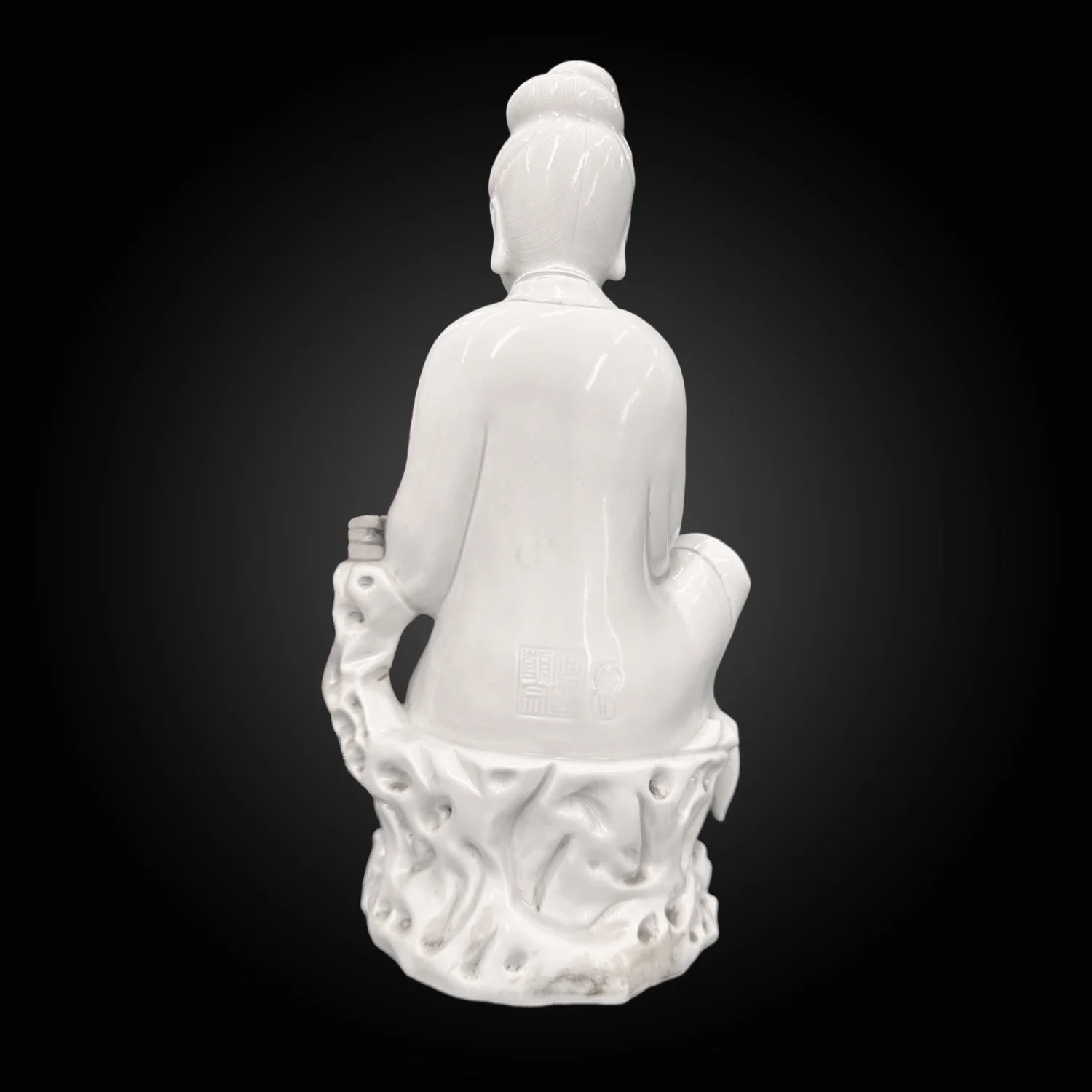 Image 2 of 4
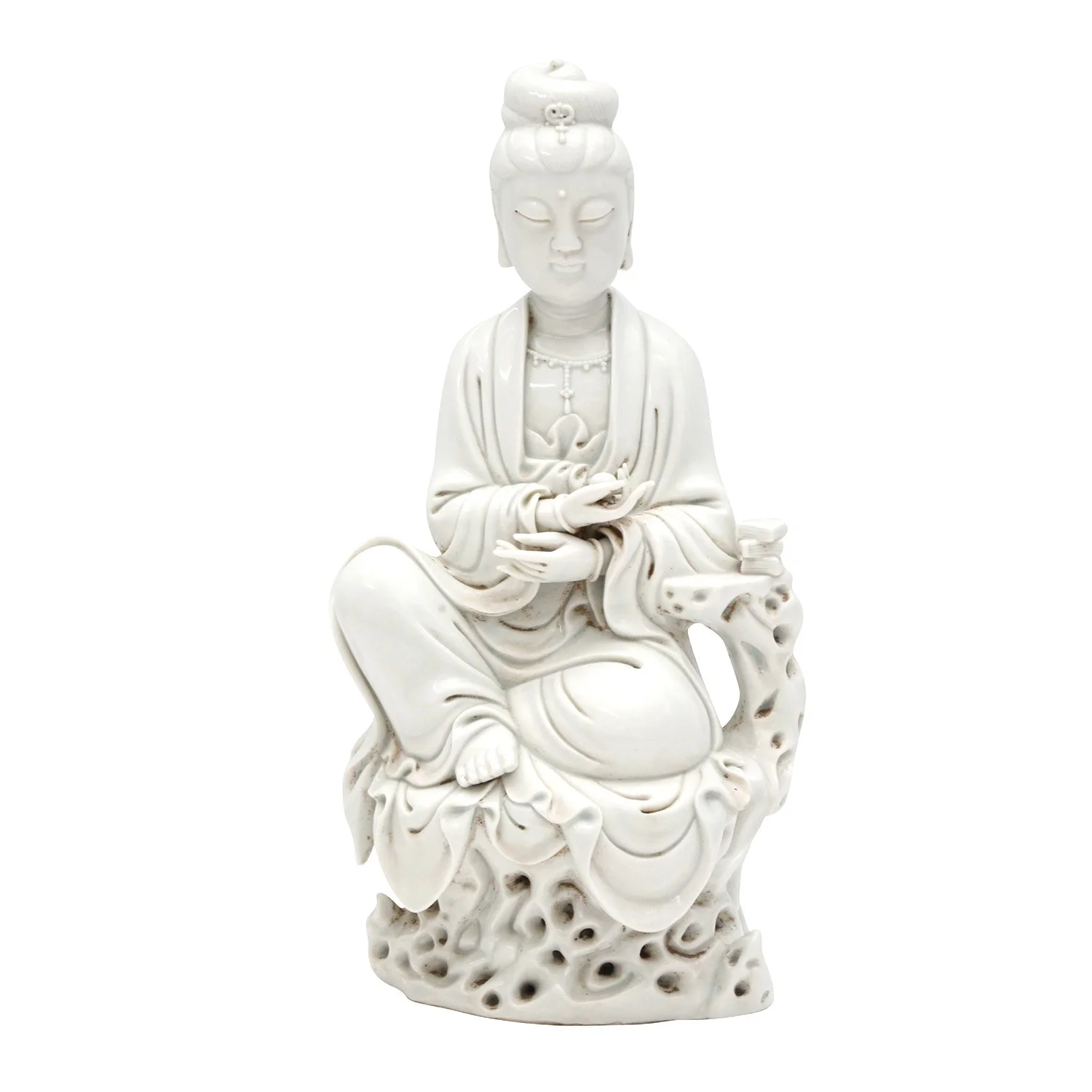 Image 3 of 4
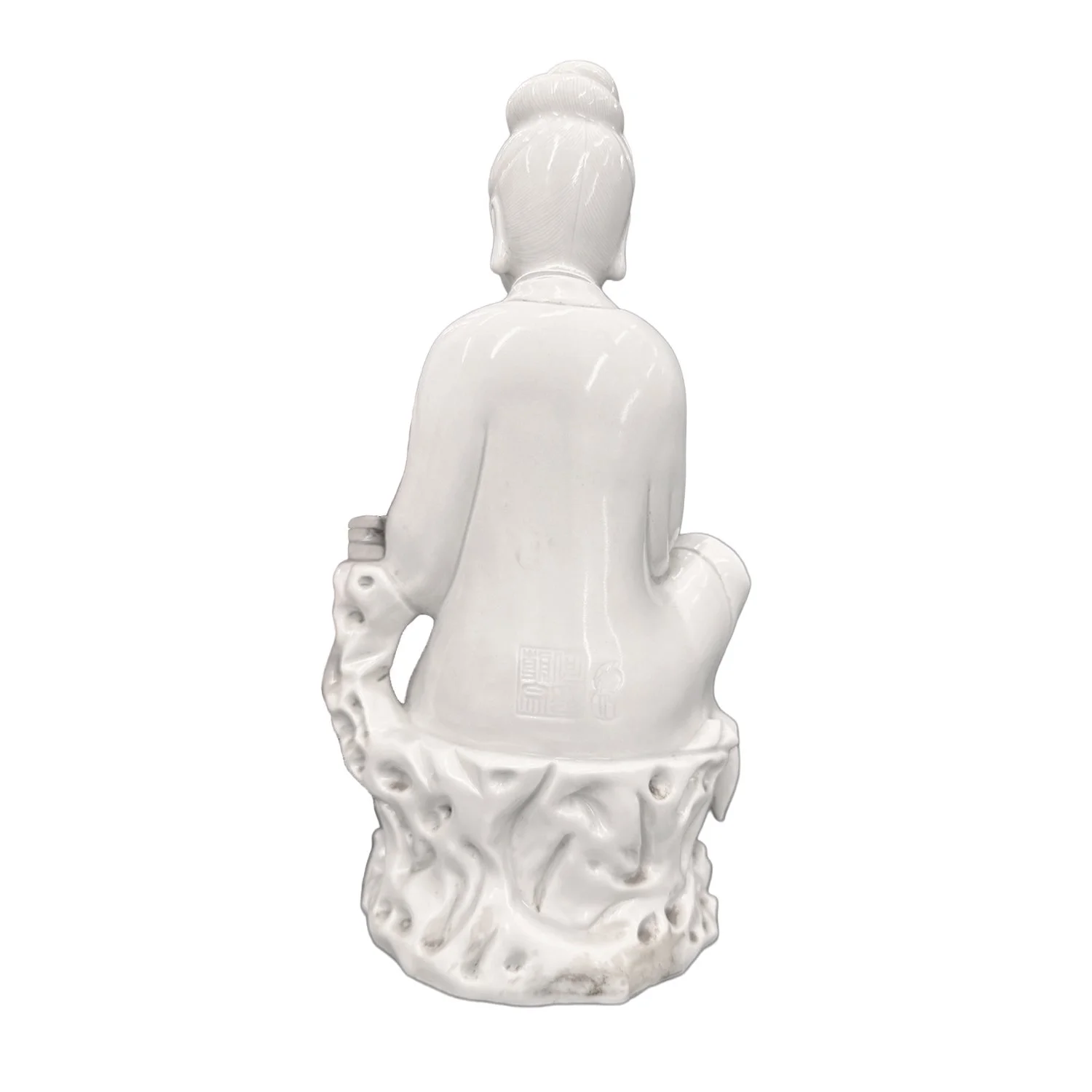 Image 4 of 4
Su, Xuejin (1869 - 1919)
A Dehua Guanyin, 19th Century
Late Qing Dynasty, Guangxu Reign (1875-1908)
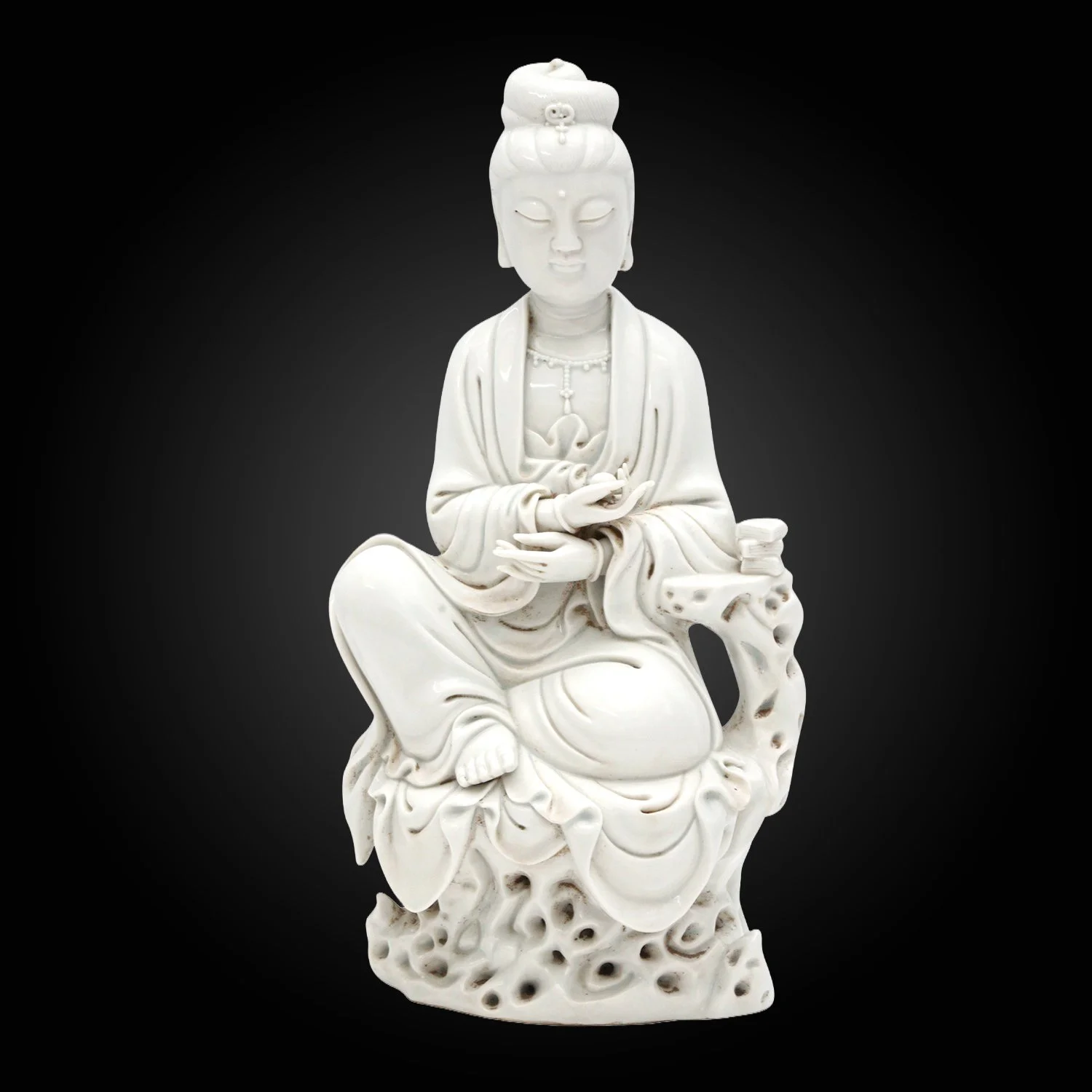
Guanyin is modeled in lalitasana pose atop tidal rocks, carrying the legendary Pearl of Light in her right hand, which illuminates the Buddhist texts on her left. Her serene gaze thus captures a moment of nocturnal enlightenment.
Su Xuejin's choice of accoutrement recalls the myth of The Dragon King, who bestowed the Pearl of Light to Guanyin via his granddaughter, Longu, in gratitude for returning him to the sea from her fishing basket.
This setting might be a reference to Su Xuejin's famous epithet "The Vastly Accomplished Fisherman" (his signature seal, "Boji Yuren"). This trademark was both a wry and a proud sentiment, celebrating his great talent despite a claimed humble background (the son of a clay modeler & wood-carver).
A masterful tribute to He Chaochun's Ming Dynasty statuary, for which Su Xuejin was well-known (as tributes after his more famous kin, He Chaozong), this particular Guanyin's iconography fits the maritime culture of Fujian, home province of the Dehua kilns, where nautical deities such as Mazu have reigned supreme for centuries.
Sumptuously crafted with a pale blue translucent overglaze puddled in the counter-relief, this circa 130 year-old blanc de chine remains in fine condition, with no restorations or losses (confirmed with U.V. analysis).
Accumulated soiling, with old label adhesive to the (reverse) base.
Signed with Su Xuejin's square 'He Chaochun' tribute seal (often misidentified as 'He Chaozong'), with a Dehua gourd beside it.
For examples by Su Xuejin from the same period & likely the same kiln see: Christie's, NYC, 2013 (Lot 18: $35,000) & Christie's, London, 2013 (Lot 26: ca. $30,000).
The Christie's, London example mirrors our Guanyin’s rendering in nearly all respects, from the fingers, hair, feet, & facial details to the bracelets, drapery, & chest ornament, to the base design & the glaze.
https://www.christies.com/en/lot/lot-5675372
Like the $30,000 Christie’s, London example, ours is one of the finest Guanyin Xuejin Su ever made.
The $14,000 price is thus, an exceptional opportunity. One never knows what special interests or bidding wars undergird high sale prices on individual items at auction. Conversely, the retail market is not one day, one battle. So, lower prices betray no flaws, only the need to consider average prices against high & low one-time sales, both at auction & from other dealers, together with value variance over time (a median trendline). The final component is judging the QUALITY and CONDITION of the property for sale versus other past market comps.
Dehua blanc de chines are notoriously fragile (I, myself, once lost a priceless piece at the hands of an overconfident packager), so the flawless condition of such an antique - as in our model for sale here today - affords it the highest possible value.
In the case of the blanc de chine on offer in this listing, both the quality and the condition are first-rank, with no other close comp being superior (at best the two circa $30,000 comps cited above are equal).
Height: ~9.5”
Note: Xuejin Su’s name is often inverted, and thus, written as Su Xuejin (family name first, as is the norm in Asia). Asian first names are also normally two parts, so in this case, the artist’s name could be anglicized as Xue Jin Su, for example (or Su Xue Jin), not including the middle name (though many Asians do not have a middle name). If your name were Liu Peilin Shen, where Shen is your middle name, the correct anglicized order would be: Pei Lin [first name] Shen [middle name] Liu [last name] = * Pei Lin Shen Liu *. To reinforce in Western countries that the second part of their first name is NOT their middle name, Asians will often hyphenate the first name, i.e. Pei-Lin Shen Liu. However, in reference to historic non-living artists (who had no need to conform to modern issues with nomenclature), art historians & auctioneers who list Asian names in Western publications often choose chunked first names, arranged by their own personal preference / prior frequency of use for a given artist as (1) last name first with no space or (2) first name first with no space (i.e. Su Xuejin / Xuejin Su). These variants are critical to recall when searching for Asian artists in the modern world, as art databases often splinter the same artists under different names, or certain auction houses prefer one variant versus another, or are unaware entirely of variants, thus confounding complete & accurate sales records.
Su, Xuejin (1869 - 1919)
A Dehua Guanyin, 19th Century
Late Qing Dynasty, Guangxu Reign (1875-1908)
Guanyin is modeled in lalitasana pose atop tidal rocks, carrying the legendary Pearl of Light in her right hand, which illuminates the Buddhist texts on her left. Her serene gaze thus captures a moment of nocturnal enlightenment.
Su Xuejin's choice of accoutrement recalls the myth of The Dragon King, who bestowed the Pearl of Light to Guanyin via his granddaughter, Longu, in gratitude for returning him to the sea from her fishing basket.
This setting might be a reference to Su Xuejin's famous epithet "The Vastly Accomplished Fisherman" (his signature seal, "Boji Yuren"). This trademark was both a wry and a proud sentiment, celebrating his great talent despite a claimed humble background (the son of a clay modeler & wood-carver).
A masterful tribute to He Chaochun's Ming Dynasty statuary, for which Su Xuejin was well-known (as tributes after his more famous kin, He Chaozong), this particular Guanyin's iconography fits the maritime culture of Fujian, home province of the Dehua kilns, where nautical deities such as Mazu have reigned supreme for centuries.
Sumptuously crafted with a pale blue translucent overglaze puddled in the counter-relief, this circa 130 year-old blanc de chine remains in fine condition, with no restorations or losses (confirmed with U.V. analysis).
Accumulated soiling, with old label adhesive to the (reverse) base.
Signed with Su Xuejin's square 'He Chaochun' tribute seal (often misidentified as 'He Chaozong'), with a Dehua gourd beside it.
For examples by Su Xuejin from the same period & likely the same kiln see: Christie's, NYC, 2013 (Lot 18: $35,000) & Christie's, London, 2013 (Lot 26: ca. $30,000).
The Christie's, London example mirrors our Guanyin’s rendering in nearly all respects, from the fingers, hair, feet, & facial details to the bracelets, drapery, & chest ornament, to the base design & the glaze.
https://www.christies.com/en/lot/lot-5675372
Like the $30,000 Christie’s, London example, ours is one of the finest Guanyin Xuejin Su ever made.
The $14,000 price is thus, an exceptional opportunity. One never knows what special interests or bidding wars undergird high sale prices on individual items at auction. Conversely, the retail market is not one day, one battle. So, lower prices betray no flaws, only the need to consider average prices against high & low one-time sales, both at auction & from other dealers, together with value variance over time (a median trendline). The final component is judging the QUALITY and CONDITION of the property for sale versus other past market comps.
Dehua blanc de chines are notoriously fragile (I, myself, once lost a priceless piece at the hands of an overconfident packager), so the flawless condition of such an antique - as in our model for sale here today - affords it the highest possible value.
In the case of the blanc de chine on offer in this listing, both the quality and the condition are first-rank, with no other close comp being superior (at best the two circa $30,000 comps cited above are equal).
Height: ~9.5”
Note: Xuejin Su’s name is often inverted, and thus, written as Su Xuejin (family name first, as is the norm in Asia). Asian first names are also normally two parts, so in this case, the artist’s name could be anglicized as Xue Jin Su, for example (or Su Xue Jin), not including the middle name (though many Asians do not have a middle name). If your name were Liu Peilin Shen, where Shen is your middle name, the correct anglicized order would be: Pei Lin [first name] Shen [middle name] Liu [last name] = * Pei Lin Shen Liu *. To reinforce in Western countries that the second part of their first name is NOT their middle name, Asians will often hyphenate the first name, i.e. Pei-Lin Shen Liu. However, in reference to historic non-living artists (who had no need to conform to modern issues with nomenclature), art historians & auctioneers who list Asian names in Western publications often choose chunked first names, arranged by their own personal preference / prior frequency of use for a given artist as (1) last name first with no space or (2) first name first with no space (i.e. Su Xuejin / Xuejin Su). These variants are critical to recall when searching for Asian artists in the modern world, as art databases often splinter the same artists under different names, or certain auction houses prefer one variant versus another, or are unaware entirely of variants, thus confounding complete & accurate sales records.