 Image 1 of 6
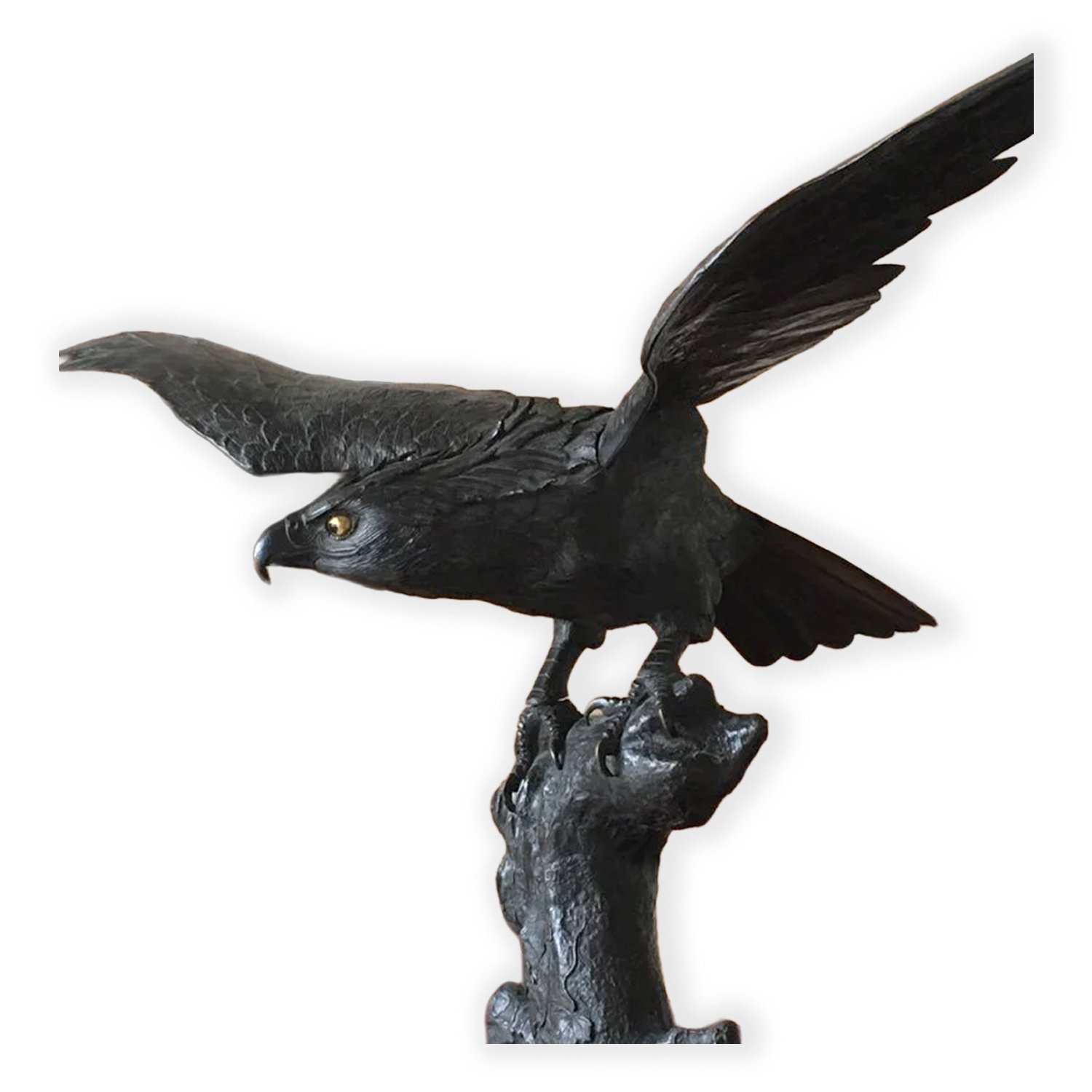 Image 2 of 6
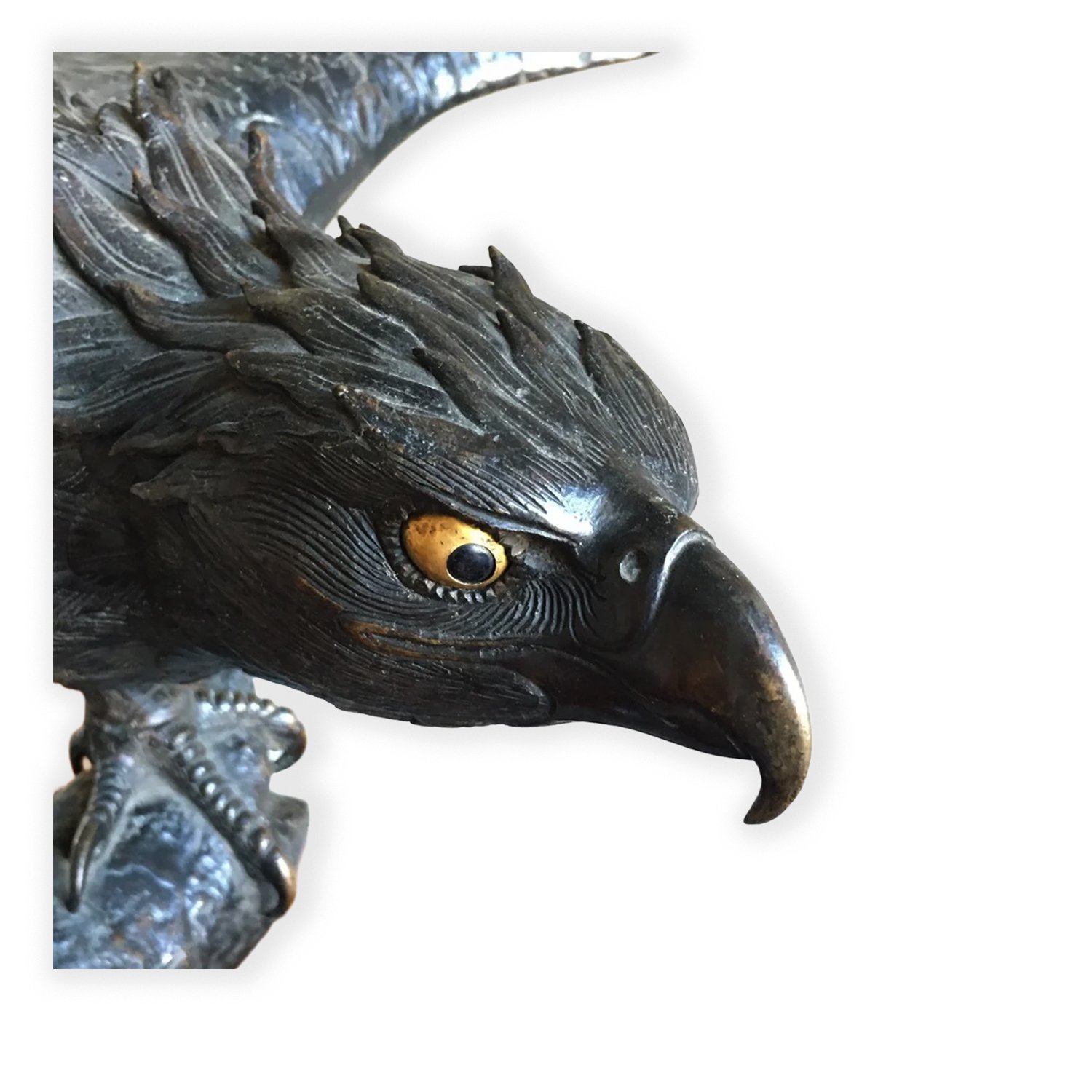 Image 3 of 6
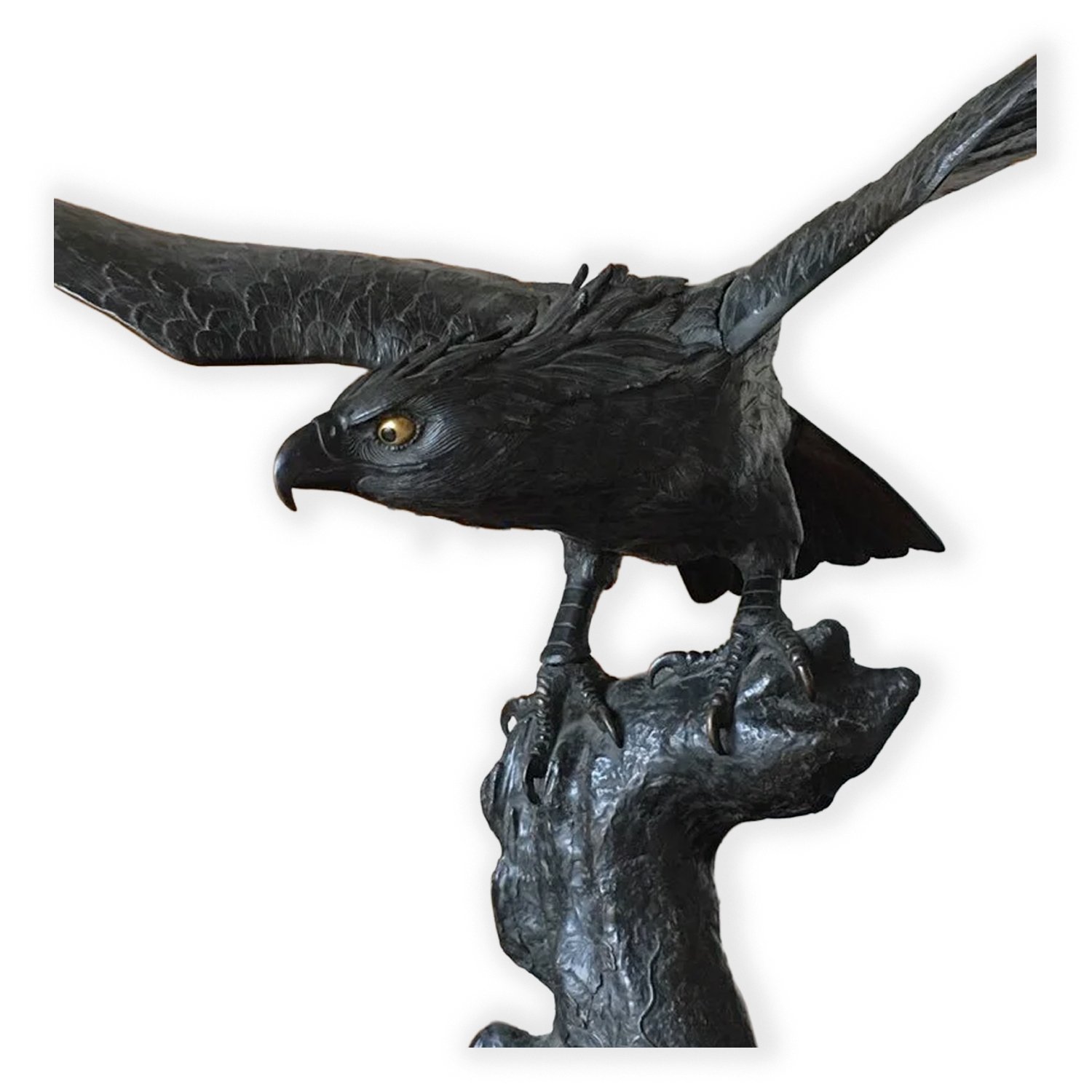 Image 4 of 6
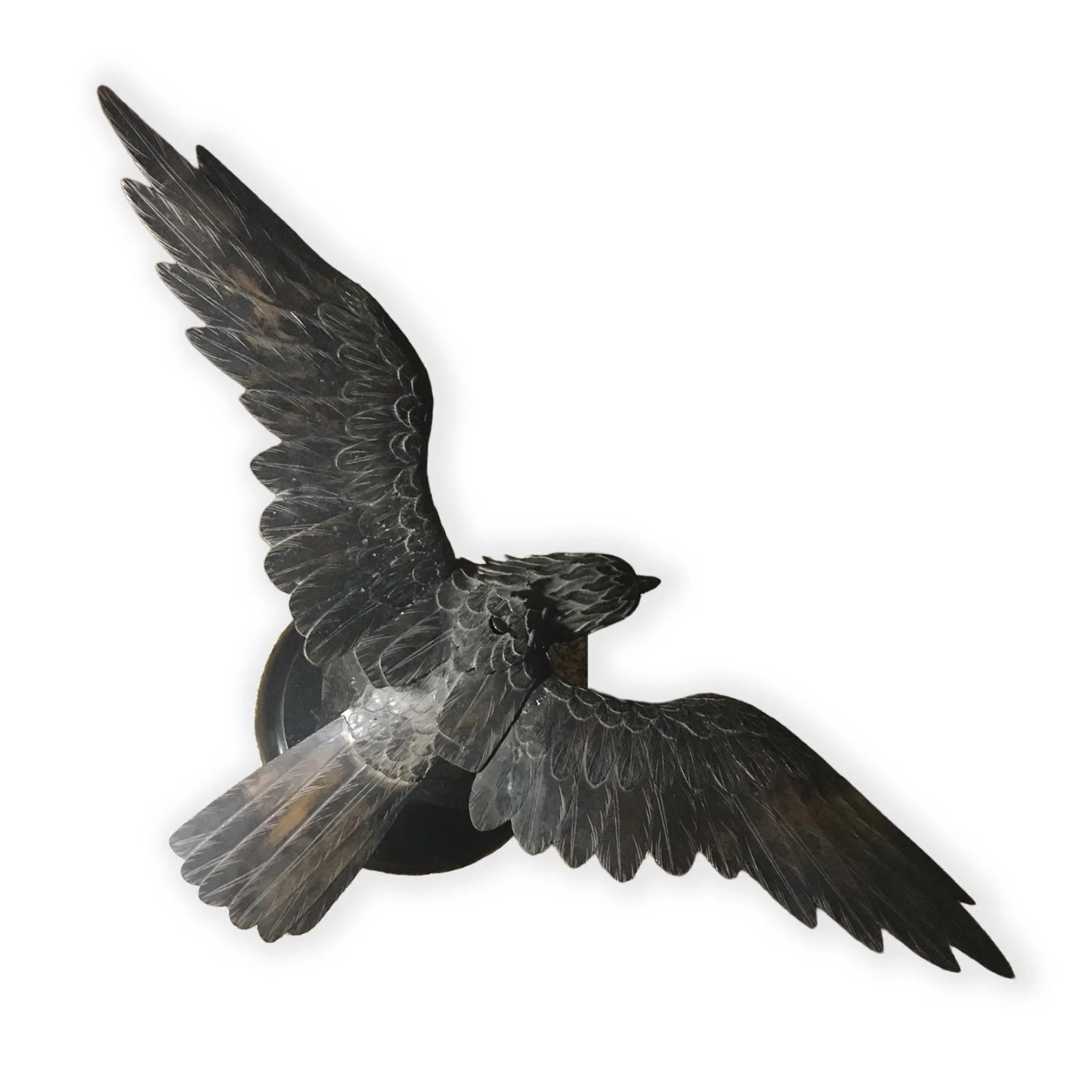 Image 5 of 6
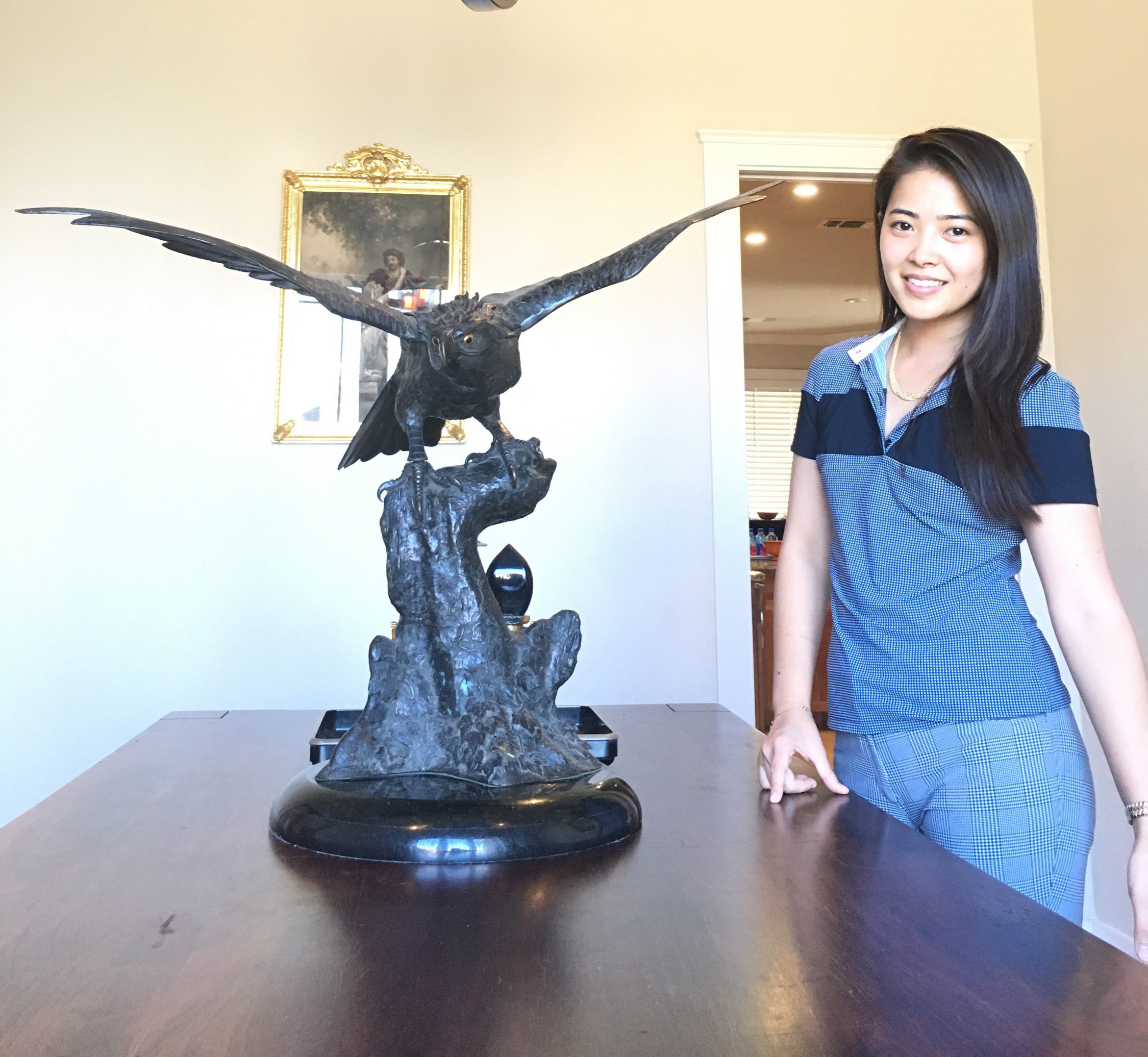 Image 6 of 6
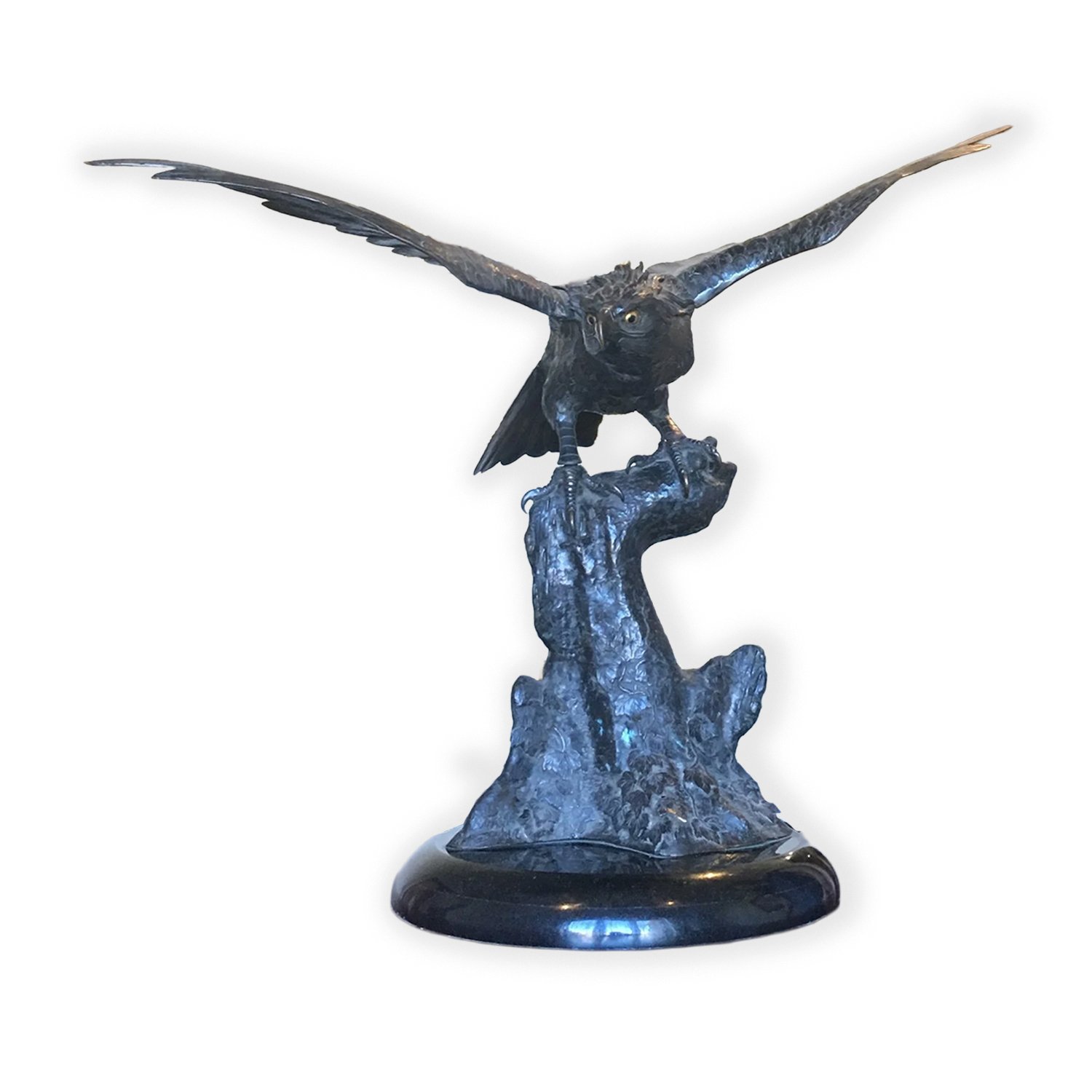
CIRCLE OF SUZUKI CHOKICHI: A LARGE MEIJI JAPANESE BRONZE EAGLE (c.1895) WITH GOLD CRYSTAL EYES
Tokyo Bronze School
Japanese Meiji Period (ca. 1895)
A Cast Bronze Eagle with Gold & Crystal Eyes
IDENTICAL STUDIO TO “THE BOSTON COLLEGE EAGLE”
ATTRIBUTED TO THE STUDIO OF SUZUKI CHOKICHI
Original patina, fine detail, powerful composition: masterful modeling in a commanding pose. This eagle's stern gaze and imposing presence sets a mood more startling than the real thing.
Largest known wingspan in its 19th century class (over 3 feet wide, approx. 38"), except for outdoor monuments, which was the original placement of the “Boston College Eagle,” prior to 21st century accession to the McMullen Museum of Art, indoors.
Fully-open wings are unusual compared to more typical renderings at rest, retracted, or semi-extended, as practical considerations typically overruled artistic freedom. Not in this case. The gigantic eagle - a force of nature - has wings unfettered, in full glory.
Many low-quality Japanese bronze eagles were produced in the mid-20th century mimicking these finer earlier models. They are found, now & then, on eBay. Of the two highest-rank classes of Meiji bronze eagles, only the deep brown (almost golden) patinated eagles where every feather is individually cast exceed the quality of this specimen. This eagle boasts individually cast body feathers, with the wings & tail feathers cast together and intricately incised. Of this type, this is one of the finest examples.
For a similar eagle (note rendering of eyes & ivy leaves) with half-closed wings, see Christie's, South Kensington: 2012 (Lot 88), which sold for appoximately $18,000 USD ($26,000 inflation-adjusted to 2026).
https://www.christies.com/en/lot/lot-5560936
Suzuki Chokichi, the renowned Imperial Japanese raptor master, created bronze eagles that tended to be stouter than the present subject, with more ovoid feather renderings, and different detailing to the legs and talons. However, he is attributed as the creator of a similar eagle to the present specimen in the famed Kahlili Collection (https://artuk.org/discover/artworks/figure-of-an-eagle-330104), which I will allow you to judge for yourself.
Due to the modular assembly of that Kahlili piece matching the points & manner of joinery at the wings of our specimen, as well as the cast & incised wings (rather than individually cast feathers on those members), a shared contemporary origin (the Kahlili piece being earlier) for these two specimens is apparent.
Overall, the Chokichi-attributed Kahlili piece more resembles the unattributed Christie’s piece cited above, both of which are emergent from an earlier time period than the present specimen. Chokichi studio pieces after 1895 likely represent an enlarging circle of workshop artisans striving to meet burgeoning demand for the master’s work. A Chokichi attribution for any quality Meiji eagle of these sizes at least triples the value - if not pushing it to 6 figures - but without signatures, is an exercise in scholarship. One typical inscription / signature area (beneath) on this bronze here for sale has never been inspected, as the eagle & perch have never been separated from the base by the present owner.
While Japanese in origin, this late 19th to early 20th century era saw an historic period of partnership & cooperation between Americans and the Japanese (the World Expositions, the gifting of the cherry blossom trees in Washington, D.C., etc.), including installation projects of monumental bronze eagles, and a collecting frenzy of all things Japanese (as with the earlier Japonisme movement in Europe).
The “Boston College Eagle” story offers a rare window into this special chapter in American art history, and was a feature of the “Eaglemania” exhibition at the McMullen Museum of Art, Boston College (Collecting Japanese Art in Gilded Age America - https://west86th.bgc.bard.edu/exhibitionnotes/eaglemania/).
THE “BOSTON COLLEGE EAGLE” (c. 1897) IS ATTRIBUTED TO THE STUDIO OF CHOKICHI, AND IS IDENTICAL IN NEARLY ALL ASPECTS OF RENDERING TO THIS EAGLE. THEY ARE ALMOST CERTAINLY FROM THE SAME STUDIO, WITHOUT QUESTION FROM THE SAME CIRCLE (THE LESSER MODIFIER APPLIED HERE), THUS SOLIDIFYING THIS EAGLE’S ATTRIBUTION TO “THE CIRCLE OF SUZUKI CHOKICHI.”
https://youtu.be/Y63MAF1pj6M?si=ZKhwsRUIpIforGFL
The main identifier of a shared modeler and caster (the same artist/s) may be found in the feathers at the head: ovoid in most autograph state eagles by Chokichi, the feathers are pointed and tufted in an inimitable way in both the Boston model and the present model here for sale.
While this, of course, represents an interpretation of perturbation in real birds, which we can observe in nature, other examples do not exaggerate the effect to this extent and in this manner, making this a fingerprint connection between the “Studio of Chokichi” Boston College Eagle, and the present piece for sale here today.
In short, these two eagle heads were produced in exactly the same way, by the same artists/artisans. The only significant difference between the Boston College Eagle and this Meiji Eagle lies in the surface details to the legs and feet. However, the construction and joinery of the legs and talons remain in common between the two, whereas, Chokichi examples attributed above the level of “Circle” or “Studio” possess legs which are typically hooded with feathers to hide the joinery.
While the Japanese’s intimate artistic animal representation is renown (with roots in their Shinto religious origins), they were also aware of their American compatriots’ love for eagles, specifically, as part of our hallowed national pagentry & iconography.
As such, many of these Meiji eagles were produced for intent of export to the American market. When set against other available eagle bronzes, therefore, ‘tis better to choose the superior Japanese quality & history over the modern, hackneyed, kitsch alternatives. Moreover, many of the modern examples that will cost you $5,000 or more are not even real cast bronze (lost wax or otherwise), but resinous powdered bronze or lower quality metallic moulds, costing the makers only a few hundred dollars or so to make, with the rest being pure profit (all for a pile of junk, which loses 95% of its value the minute you buy it).
If your goal is a gorgeous and imposing piece of power art, you will be over the moon with this artwork. Just be sure your desk or stand is strong enough to support it! This is one serious piece of bronze, and it weighs a proverbial TON.
A very heavy, very large, and very masculine bronze statue. If you are an American power-oriented businessman, this totem is a very intimidating wingman (no pun intended) when signing deals at the desk (think Dallas…).
High-priced, low-quality reproduction galleries produce authoritative eagle statues for the offices of patriotic CEOs of the traditional business world, but they fail in every respect compared to the quality & grandeur of an antique masterpiece like this.
P.S.
See the 2019 NGA, D.C. exhibition catalog “The Life of Animals in Japanese Art” (conceived of & authored by another old friend of mine) for a broad view of how an inimitably Japanese soul & skill imbued itself into their artistic creations of all things animal.
OUR UNIQUE PRICE TRANSPARENCY:
Japanese bronze eagles & hawks of the Meiji period are highly collectible, and carry substantial premiums over other bronze eagle or hawk statuary. Leaving aside the Chokichi association, numerous (some smaller, or some near-equal in size) Meiji bronze examples inferior to this one can be found at galleries or online for $10,000 to $25,000, with a $15,000 minimum for this general size & quality.
Mounted on a round black quartz base.
Offers are always welcome, and will be considered.
We cover all shipping & crating FREE, which means we will lose $1,000 to $3,000+ to professionally crate & freight this bronze to you. An artwork damaged in transit is never an acceptable part of any art transaction with us.
Provenance:
Art Market, Southwestern U.S.A.
Property of a Philanthropist of the Arts & Sciences, 2022.
Tokyo Bronze School
Japanese Meiji Period (ca. 1895)
A Cast Bronze Eagle with Gold & Crystal Eyes
IDENTICAL STUDIO TO “THE BOSTON COLLEGE EAGLE”
ATTRIBUTED TO THE STUDIO OF SUZUKI CHOKICHI
Original patina, fine detail, powerful composition: masterful modeling in a commanding pose. This eagle's stern gaze and imposing presence sets a mood more startling than the real thing.
Largest known wingspan in its 19th century class (over 3 feet wide, approx. 38"), except for outdoor monuments, which was the original placement of the “Boston College Eagle,” prior to 21st century accession to the McMullen Museum of Art, indoors.
Fully-open wings are unusual compared to more typical renderings at rest, retracted, or semi-extended, as practical considerations typically overruled artistic freedom. Not in this case. The gigantic eagle - a force of nature - has wings unfettered, in full glory.
Many low-quality Japanese bronze eagles were produced in the mid-20th century mimicking these finer earlier models. They are found, now & then, on eBay. Of the two highest-rank classes of Meiji bronze eagles, only the deep brown (almost golden) patinated eagles where every feather is individually cast exceed the quality of this specimen. This eagle boasts individually cast body feathers, with the wings & tail feathers cast together and intricately incised. Of this type, this is one of the finest examples.
For a similar eagle (note rendering of eyes & ivy leaves) with half-closed wings, see Christie's, South Kensington: 2012 (Lot 88), which sold for appoximately $18,000 USD ($26,000 inflation-adjusted to 2026).
https://www.christies.com/en/lot/lot-5560936
Suzuki Chokichi, the renowned Imperial Japanese raptor master, created bronze eagles that tended to be stouter than the present subject, with more ovoid feather renderings, and different detailing to the legs and talons. However, he is attributed as the creator of a similar eagle to the present specimen in the famed Kahlili Collection (https://artuk.org/discover/artworks/figure-of-an-eagle-330104), which I will allow you to judge for yourself.
Due to the modular assembly of that Kahlili piece matching the points & manner of joinery at the wings of our specimen, as well as the cast & incised wings (rather than individually cast feathers on those members), a shared contemporary origin (the Kahlili piece being earlier) for these two specimens is apparent.
Overall, the Chokichi-attributed Kahlili piece more resembles the unattributed Christie’s piece cited above, both of which are emergent from an earlier time period than the present specimen. Chokichi studio pieces after 1895 likely represent an enlarging circle of workshop artisans striving to meet burgeoning demand for the master’s work. A Chokichi attribution for any quality Meiji eagle of these sizes at least triples the value - if not pushing it to 6 figures - but without signatures, is an exercise in scholarship. One typical inscription / signature area (beneath) on this bronze here for sale has never been inspected, as the eagle & perch have never been separated from the base by the present owner.
While Japanese in origin, this late 19th to early 20th century era saw an historic period of partnership & cooperation between Americans and the Japanese (the World Expositions, the gifting of the cherry blossom trees in Washington, D.C., etc.), including installation projects of monumental bronze eagles, and a collecting frenzy of all things Japanese (as with the earlier Japonisme movement in Europe).
The “Boston College Eagle” story offers a rare window into this special chapter in American art history, and was a feature of the “Eaglemania” exhibition at the McMullen Museum of Art, Boston College (Collecting Japanese Art in Gilded Age America - https://west86th.bgc.bard.edu/exhibitionnotes/eaglemania/).
THE “BOSTON COLLEGE EAGLE” (c. 1897) IS ATTRIBUTED TO THE STUDIO OF CHOKICHI, AND IS IDENTICAL IN NEARLY ALL ASPECTS OF RENDERING TO THIS EAGLE. THEY ARE ALMOST CERTAINLY FROM THE SAME STUDIO, WITHOUT QUESTION FROM THE SAME CIRCLE (THE LESSER MODIFIER APPLIED HERE), THUS SOLIDIFYING THIS EAGLE’S ATTRIBUTION TO “THE CIRCLE OF SUZUKI CHOKICHI.”
https://youtu.be/Y63MAF1pj6M?si=ZKhwsRUIpIforGFL
The main identifier of a shared modeler and caster (the same artist/s) may be found in the feathers at the head: ovoid in most autograph state eagles by Chokichi, the feathers are pointed and tufted in an inimitable way in both the Boston model and the present model here for sale.
While this, of course, represents an interpretation of perturbation in real birds, which we can observe in nature, other examples do not exaggerate the effect to this extent and in this manner, making this a fingerprint connection between the “Studio of Chokichi” Boston College Eagle, and the present piece for sale here today.
In short, these two eagle heads were produced in exactly the same way, by the same artists/artisans. The only significant difference between the Boston College Eagle and this Meiji Eagle lies in the surface details to the legs and feet. However, the construction and joinery of the legs and talons remain in common between the two, whereas, Chokichi examples attributed above the level of “Circle” or “Studio” possess legs which are typically hooded with feathers to hide the joinery.
While the Japanese’s intimate artistic animal representation is renown (with roots in their Shinto religious origins), they were also aware of their American compatriots’ love for eagles, specifically, as part of our hallowed national pagentry & iconography.
As such, many of these Meiji eagles were produced for intent of export to the American market. When set against other available eagle bronzes, therefore, ‘tis better to choose the superior Japanese quality & history over the modern, hackneyed, kitsch alternatives. Moreover, many of the modern examples that will cost you $5,000 or more are not even real cast bronze (lost wax or otherwise), but resinous powdered bronze or lower quality metallic moulds, costing the makers only a few hundred dollars or so to make, with the rest being pure profit (all for a pile of junk, which loses 95% of its value the minute you buy it).
If your goal is a gorgeous and imposing piece of power art, you will be over the moon with this artwork. Just be sure your desk or stand is strong enough to support it! This is one serious piece of bronze, and it weighs a proverbial TON.
A very heavy, very large, and very masculine bronze statue. If you are an American power-oriented businessman, this totem is a very intimidating wingman (no pun intended) when signing deals at the desk (think Dallas…).
High-priced, low-quality reproduction galleries produce authoritative eagle statues for the offices of patriotic CEOs of the traditional business world, but they fail in every respect compared to the quality & grandeur of an antique masterpiece like this.
P.S.
See the 2019 NGA, D.C. exhibition catalog “The Life of Animals in Japanese Art” (conceived of & authored by another old friend of mine) for a broad view of how an inimitably Japanese soul & skill imbued itself into their artistic creations of all things animal.
OUR UNIQUE PRICE TRANSPARENCY:
Japanese bronze eagles & hawks of the Meiji period are highly collectible, and carry substantial premiums over other bronze eagle or hawk statuary. Leaving aside the Chokichi association, numerous (some smaller, or some near-equal in size) Meiji bronze examples inferior to this one can be found at galleries or online for $10,000 to $25,000, with a $15,000 minimum for this general size & quality.
Mounted on a round black quartz base.
Offers are always welcome, and will be considered.
We cover all shipping & crating FREE, which means we will lose $1,000 to $3,000+ to professionally crate & freight this bronze to you. An artwork damaged in transit is never an acceptable part of any art transaction with us.
Provenance:
Art Market, Southwestern U.S.A.
Property of a Philanthropist of the Arts & Sciences, 2022.