 Image 1 of 4
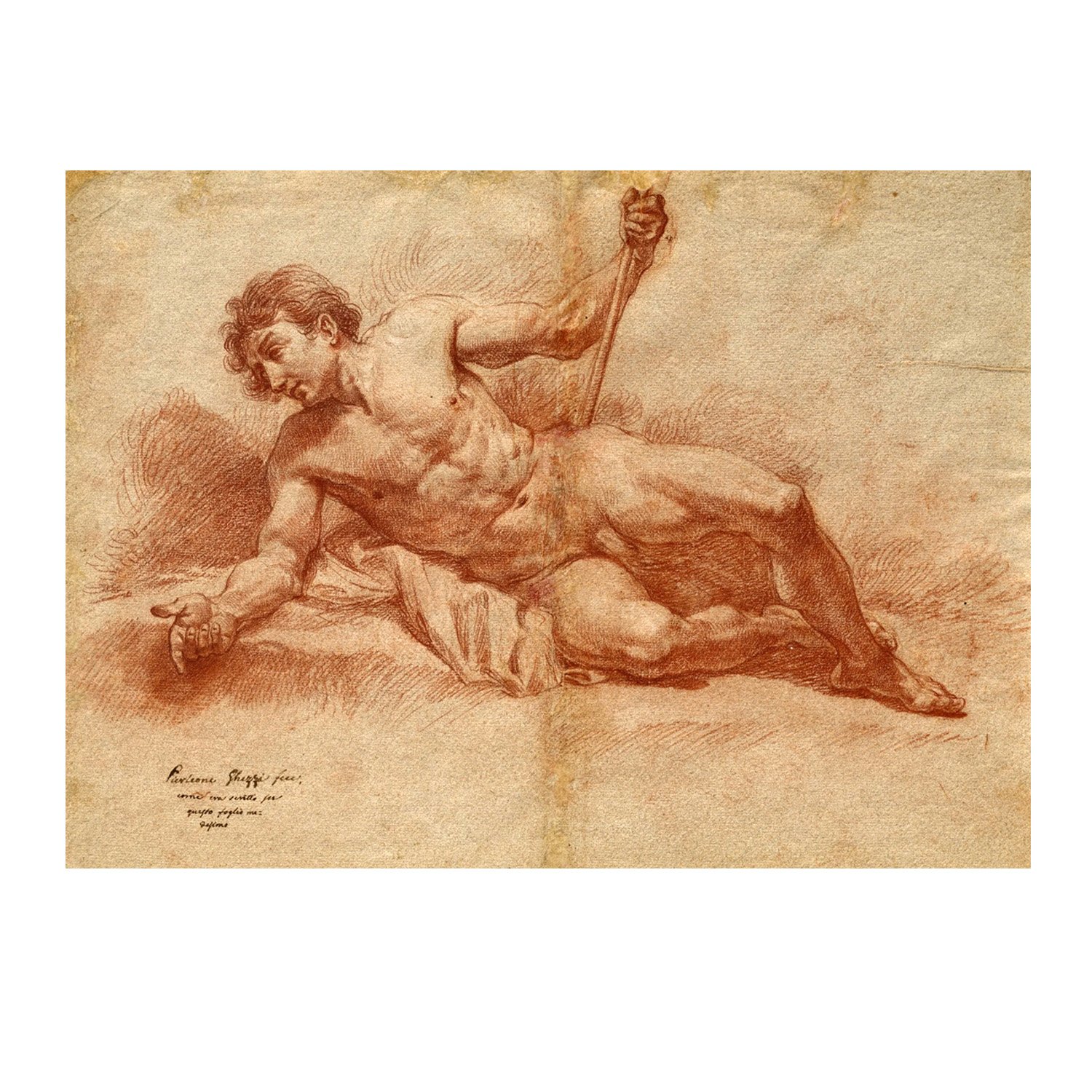 Image 2 of 4
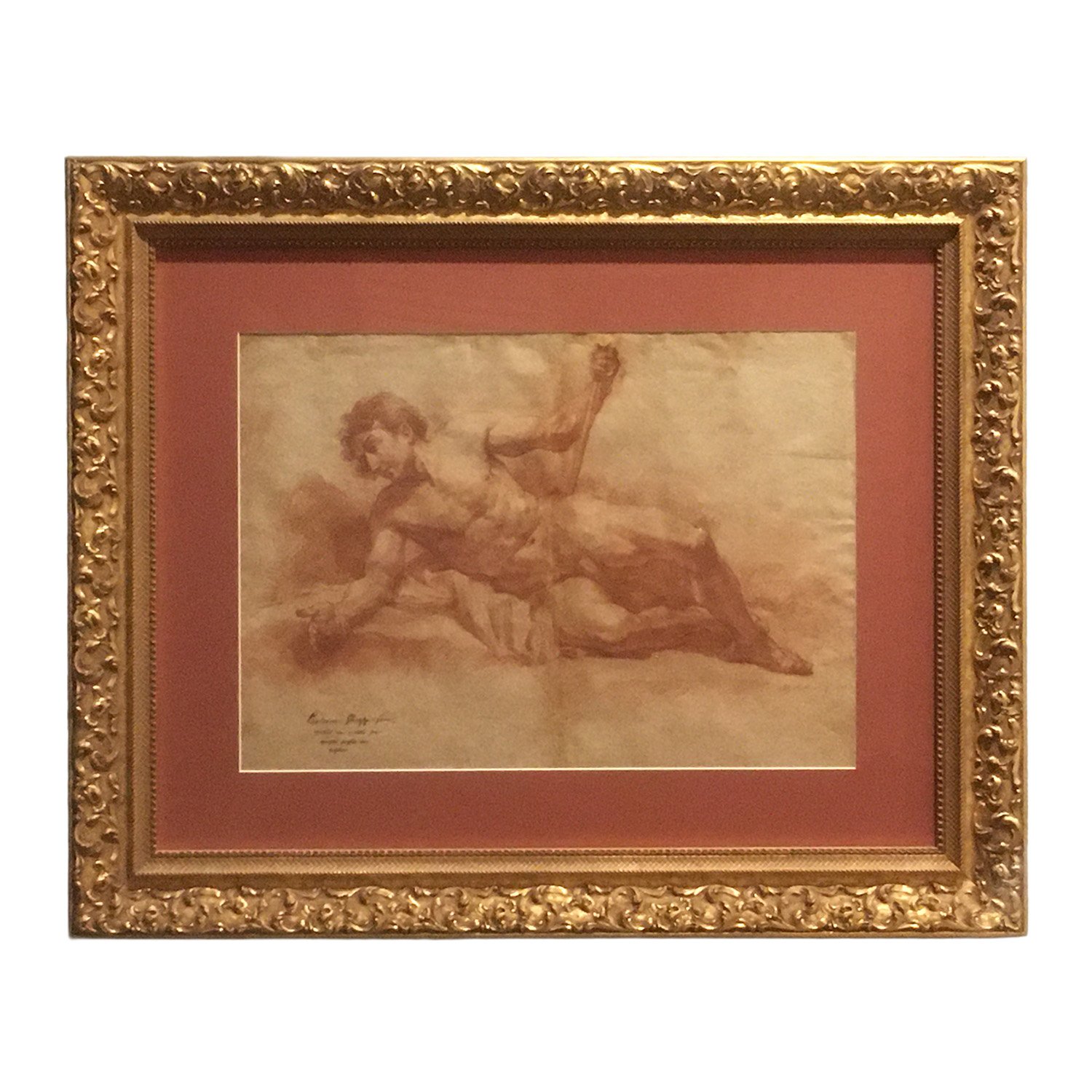 Image 3 of 4
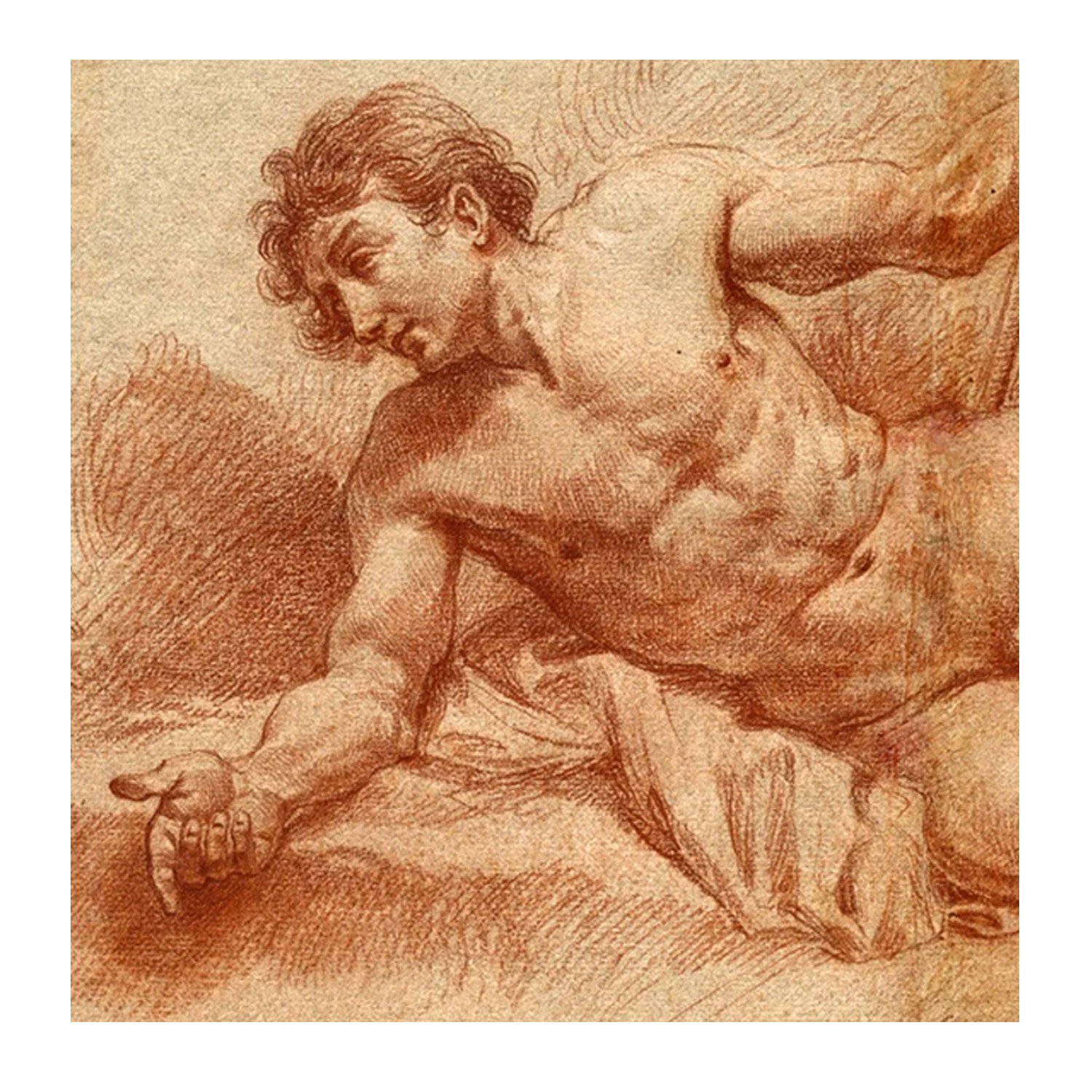 Image 4 of 4
PIER LEONE GHEZZI (1674-1755) RED CHALK OLD MASTER NUDE EX-ROTHSCHILD
* Purchased at Christie’s, NYC *
PIER LEONE GHEZZI (ROME 1674-1755)
**FORMER PROPERTY OF THE ROTHSCHILD FAMILY**
A DUAL-SIDED DRAWING
POSSIBLY CAIN AND ABEL
RECTO & VERSO PORTRAITS ARE EQUAL IN QUALITY
EITHER MAY BE DISPLAYED AS PRIMARY IMAGE TO YOUR TASTE
TWO DRAWINGS FOR THE PRICE OF ONE
Pier Leone Ghezzi is the second artist available from our collection (the other being the legendary 18th century British caricaturist, Thomas Patch) who was famous not only for his fine oil on canvas paintings, but also for his monochrome caricature drawings - a not at all typical side-hustle for Old Master geniuses.
Ghezzi lived a very privileged life as an artist, with a father on the Accademia di San Luca, which was the Academy in Rome, and immediate family working as artists and architects for the Papacy and wider Vatican projects.
As curator of the the Papal Collections and painter to the Papal Treasury, he rendered portraits of his benefactor, Pope Clement XI, and painted the San Sebastiano church of his ancestors. Rounding-out his most substantial (and extent) interior commissions of his famed “naturalistic” frescos & wall paintings under the aegis of Clement XI were his sprawling bucolic scenes at the Castel Gandolfo.
Beyond these mostly Papal commissions, Ghezzi’s well-born connections included a host of noble patrons for whom he drew or painted (and famously, produced caricatures of, earning himself the epithet of “first professional caricaturist"), most importantly, the Duke of Parma, from whom he received his Cavalieri title (Knight or “Sir” in Italian) - a title I know well, as my grandfather also held it (albeit two centuries later). The inevitable demise of Clement XI led to a secular support stream from the Falconieri family, whose villa he covered with frescos in fantasized historical genre featuring action portraits of his patrons.
Notable to collectors is the fact that (like so many other bygone academy painters in our modern world that so cherishes individuality, iconoclasm, and the rebel spirit; cf. Caravaggio, Picasso, Van Gogh, Modigliani, etc.) Ghezzi’s oil paintings have little to no traction on the art marrket, whereas his caricature drawings are seen most frequently, but above them all in VALUE stands his refined, elegant, and brilliant Old Master drawings! Particularly those in black chalk or red chalk, like this drawing!
Ghezzi’s Portrait of Serafino and Francesco Falsacapa Seated at a Table Studying and Writing achieved the sale price at Christie’s of $68,500 against a $30,000 to $50,000 estimate, or about $134,000 inflation-adjusted from 1999 to 2026.
Moreover, this same drawing (in chalk and ink) was later featured in Ghezzi’s seminal 1999 exhibition in Italy: Pier Leone Ghezzi: Settecento Alla Moda - underscoring the primacy in both value and scholarship of Ghezzi’s masterful, uninhibited drawings above his formalized paintings.
One cannot understate the grandeur of discovering TWO incredible Old Master drawings of FIRST RANK quality upon the same 1700s sheet, preserved so beautifully, and framed in such a way that both sides may be seen (the verso through a custom rear window). While you can make your own choice, I have surveyed an equal margin of those who prefer one over the other, and for myself, I have displayed both at various times. The current framing favors the landscape format reclining nude, while one might flip the drawing (possibly reusing the same mat) to display the seated nude, together with the faint leg motion studies beneath.
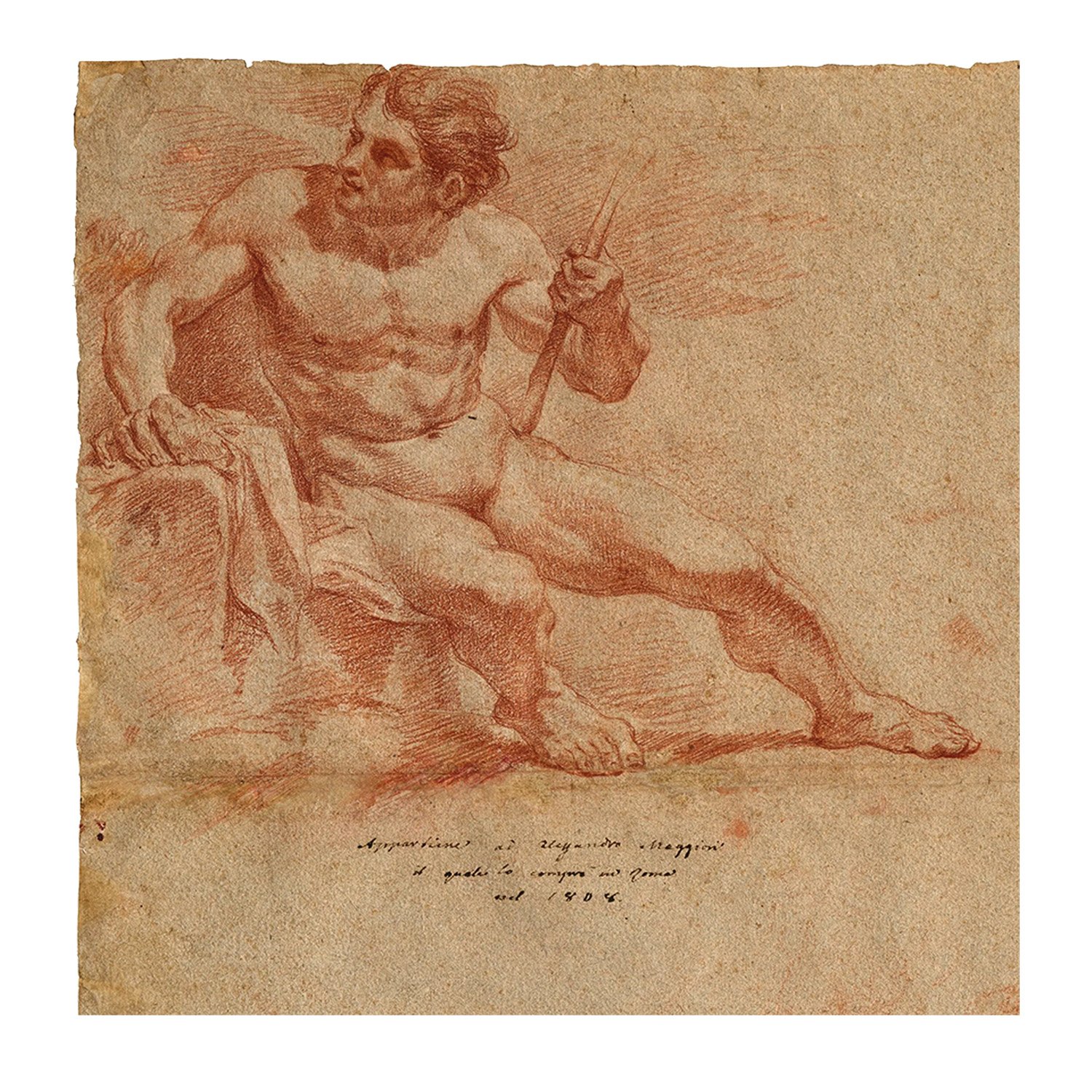
The two drawings (front & back) feature the same model in contrasting positions: (1) apparently slipping towards death, semi-suppine (notice the downward pointing hand, and the shaft seemingly stuck in his side), and (2) wild-eyed with a disturbed posture, seated with a humerus or femur bone in his hand. This bone was previously undetected by other experts, but verified after analysis of the sketching. N.B. Christie’s original 2023 auction FAILED TO PROVIDE ANY PHOTOGRAPHS OF THIS SECOND VERSO DRAWING!! Thus, other buyers were neither able to bid for the beauty of the second drawing, nor study the possibility of such illuminating details as have now been discovered.
The identification of what was presumed a “stick” as, instead, a bone should eventually reveal the literary reference and identity of the sitter.
A candidate emerges from the Biblical story of Cain and Abel for several points: (A) while not specified in the Bible, early medieval Christian traditions begin to record and depict Cain’s weapon as a bone (often a donkey’s jawbone, later recounted in Shakespeare, but in other artistic sources, including Italian near-contemporaries, frequently long bones, as here depicted by Ghezzi), (B) the crazed look in the seated figure’s eyes consistent with the act of murder, bone provacatively raised, along with windswept hair suggesting an exterior location, (C) the fact the putative Cain (verso) is seated astride what might be the sacrifical altar identified in the Bible, often depicted in other paintings alongside the scene of Cain slaying Abel with a bone (again, in contrast to the textual “field” location), and (D) the fact that this sheet so unusually (notwithstanding palimpsest traditions) depicts two large, masterful drawings front & back of clearly related figures crafted beyond mere study states, with the recto figure emphatically displaying the traditional artistic gesture for imminent death with his hand, such that he could be Abel, run-through with the bone depicted in Cain’s hand verso (despite use of the same model for both). Future study is warranted, but the evidence above suggests a tantalizing possibilty for an artist, Ghezzi, well-known for his Biblical narratives.
The model, himself, was used by Ghezzi in other drawings currently in the Louvre (SEE: Deux Mains et Deux Têtes d'Hommes, INV 15810, Recto, Département des Arts Graphiques, THE LOUVRE: https://collections.louvre.fr/en/ark:/53355/cl020203097).
Preparatory drawings for a Ghezzi painting of Christ on the cross with surrounding Biblical personages is referenced in the Louvre notes relevant to the cited model studies: “Etude pour le Christ en croix avec saint Antoine, saint Isidore, santa Giuliana Falconieri et le bienheureux Alexis Falconieri, peinture à la tempera de la chapelle du château de Torrimpietra, résidence du cardinal Alessandro Falconieri, à l'exterieur de Rome.”
The chapel referenced is adjunct to the historic Falconieri castle: Castello di Torre in Pietra on the outskirts of Rome, where the main estate is now a farm, with the castle having been restored in the 20th century by the Albertini family, and maintained to the present day (https://castelloditorreinpietra.com/en/the-castle/).
The Rothschild Family is famous not only as the richest family in the history of the world, but also as the family (for centuries) possessed of the world’s greatest art collections (plural, as the family is branched and globalized). As such, Christie’s named the sale in which we purchased the present piece Le Goût Rothschild, French for “The Rothschild Taste” - in other words, the best taste for art in the world.
Ergo, you may depend upon this magnificent Old Master drawing by Pier Leone Ghezzi to be among the best in the world - if not the very best that Ghezzi ever drew.
And if anyone ever disagrees, you can always flip it over, and prove them wrong... :-)
Since, like the Roman god, Janus, this drawing has TWO FACES (two sides, front & back), and each of the two drawings is wonderfully opposite to the other.
It is my learned opinion that the drawing Christie’s never illustrated for the Rothschild auction (seated nude male, verso), is superior to the recumbent recto drawing, and truly the finest work Ghezzi ever created. I also believe this to be one motivating factor behind the Rothschilds buying this artwork in the first place.
I consider this to be among my finest pieces, regardless of having paid much more for others. You will NOT be disappointed.
Please note the beautiful handwritten ink inscriptions (like the Reliable Venetian Hand - RVH) are those of the collector, Alessandro Maggiori, and are crucial to provenancing the artwork:
“Pierleone Ghezzi fece. come era scritto per questo foglio me- desimo”
AND
“Appartiene ad Alessandro Maggiori il quale lo comprò in Roma nel 1808”
*with oval initialed watermark*
DIMENSIONS: approx. ~15” by ~21”
PROVENANCE:
Alessandro Maggiori (1764-1834): Rome, 1808.
Mrs. Lester Cook: Sotheby’s, London, 1984.
The Collection of the Rothschild Family.
Christie’s, New York, Le Goût Rothschild Sale, 2023.
PUBLISHED:
M.C. Dorati da Empoli, Pier Leone Ghezzi, Un Protagonista del Settecento Romano, Rome, 2008, p. 49.
* Purchased at Christie’s, NYC *
PIER LEONE GHEZZI (ROME 1674-1755)
**FORMER PROPERTY OF THE ROTHSCHILD FAMILY**
A DUAL-SIDED DRAWING
POSSIBLY CAIN AND ABEL
RECTO & VERSO PORTRAITS ARE EQUAL IN QUALITY
EITHER MAY BE DISPLAYED AS PRIMARY IMAGE TO YOUR TASTE
TWO DRAWINGS FOR THE PRICE OF ONE
Pier Leone Ghezzi is the second artist available from our collection (the other being the legendary 18th century British caricaturist, Thomas Patch) who was famous not only for his fine oil on canvas paintings, but also for his monochrome caricature drawings - a not at all typical side-hustle for Old Master geniuses.
Ghezzi lived a very privileged life as an artist, with a father on the Accademia di San Luca, which was the Academy in Rome, and immediate family working as artists and architects for the Papacy and wider Vatican projects.
As curator of the the Papal Collections and painter to the Papal Treasury, he rendered portraits of his benefactor, Pope Clement XI, and painted the San Sebastiano church of his ancestors. Rounding-out his most substantial (and extent) interior commissions of his famed “naturalistic” frescos & wall paintings under the aegis of Clement XI were his sprawling bucolic scenes at the Castel Gandolfo.
Beyond these mostly Papal commissions, Ghezzi’s well-born connections included a host of noble patrons for whom he drew or painted (and famously, produced caricatures of, earning himself the epithet of “first professional caricaturist"), most importantly, the Duke of Parma, from whom he received his Cavalieri title (Knight or “Sir” in Italian) - a title I know well, as my grandfather also held it (albeit two centuries later). The inevitable demise of Clement XI led to a secular support stream from the Falconieri family, whose villa he covered with frescos in fantasized historical genre featuring action portraits of his patrons.
Notable to collectors is the fact that (like so many other bygone academy painters in our modern world that so cherishes individuality, iconoclasm, and the rebel spirit; cf. Caravaggio, Picasso, Van Gogh, Modigliani, etc.) Ghezzi’s oil paintings have little to no traction on the art marrket, whereas his caricature drawings are seen most frequently, but above them all in VALUE stands his refined, elegant, and brilliant Old Master drawings! Particularly those in black chalk or red chalk, like this drawing!
Ghezzi’s Portrait of Serafino and Francesco Falsacapa Seated at a Table Studying and Writing achieved the sale price at Christie’s of $68,500 against a $30,000 to $50,000 estimate, or about $134,000 inflation-adjusted from 1999 to 2026.
Moreover, this same drawing (in chalk and ink) was later featured in Ghezzi’s seminal 1999 exhibition in Italy: Pier Leone Ghezzi: Settecento Alla Moda - underscoring the primacy in both value and scholarship of Ghezzi’s masterful, uninhibited drawings above his formalized paintings.
One cannot understate the grandeur of discovering TWO incredible Old Master drawings of FIRST RANK quality upon the same 1700s sheet, preserved so beautifully, and framed in such a way that both sides may be seen (the verso through a custom rear window). While you can make your own choice, I have surveyed an equal margin of those who prefer one over the other, and for myself, I have displayed both at various times. The current framing favors the landscape format reclining nude, while one might flip the drawing (possibly reusing the same mat) to display the seated nude, together with the faint leg motion studies beneath.
The two drawings (front & back) feature the same model in contrasting positions: (1) apparently slipping towards death, semi-suppine (notice the downward pointing hand, and the shaft seemingly stuck in his side), and (2) wild-eyed with a disturbed posture, seated with a humerus or femur bone in his hand. This bone was previously undetected by other experts, but verified after analysis of the sketching. N.B. Christie’s original 2023 auction FAILED TO PROVIDE ANY PHOTOGRAPHS OF THIS SECOND VERSO DRAWING!! Thus, other buyers were neither able to bid for the beauty of the second drawing, nor study the possibility of such illuminating details as have now been discovered.
The identification of what was presumed a “stick” as, instead, a bone should eventually reveal the literary reference and identity of the sitter.
A candidate emerges from the Biblical story of Cain and Abel for several points: (A) while not specified in the Bible, early medieval Christian traditions begin to record and depict Cain’s weapon as a bone (often a donkey’s jawbone, later recounted in Shakespeare, but in other artistic sources, including Italian near-contemporaries, frequently long bones, as here depicted by Ghezzi), (B) the crazed look in the seated figure’s eyes consistent with the act of murder, bone provacatively raised, along with windswept hair suggesting an exterior location, (C) the fact the putative Cain (verso) is seated astride what might be the sacrifical altar identified in the Bible, often depicted in other paintings alongside the scene of Cain slaying Abel with a bone (again, in contrast to the textual “field” location), and (D) the fact that this sheet so unusually (notwithstanding palimpsest traditions) depicts two large, masterful drawings front & back of clearly related figures crafted beyond mere study states, with the recto figure emphatically displaying the traditional artistic gesture for imminent death with his hand, such that he could be Abel, run-through with the bone depicted in Cain’s hand verso (despite use of the same model for both). Future study is warranted, but the evidence above suggests a tantalizing possibilty for an artist, Ghezzi, well-known for his Biblical narratives.
The model, himself, was used by Ghezzi in other drawings currently in the Louvre (SEE: Deux Mains et Deux Têtes d'Hommes, INV 15810, Recto, Département des Arts Graphiques, THE LOUVRE: https://collections.louvre.fr/en/ark:/53355/cl020203097).
Preparatory drawings for a Ghezzi painting of Christ on the cross with surrounding Biblical personages is referenced in the Louvre notes relevant to the cited model studies: “Etude pour le Christ en croix avec saint Antoine, saint Isidore, santa Giuliana Falconieri et le bienheureux Alexis Falconieri, peinture à la tempera de la chapelle du château de Torrimpietra, résidence du cardinal Alessandro Falconieri, à l'exterieur de Rome.”
The chapel referenced is adjunct to the historic Falconieri castle: Castello di Torre in Pietra on the outskirts of Rome, where the main estate is now a farm, with the castle having been restored in the 20th century by the Albertini family, and maintained to the present day (https://castelloditorreinpietra.com/en/the-castle/).
The Rothschild Family is famous not only as the richest family in the history of the world, but also as the family (for centuries) possessed of the world’s greatest art collections (plural, as the family is branched and globalized). As such, Christie’s named the sale in which we purchased the present piece Le Goût Rothschild, French for “The Rothschild Taste” - in other words, the best taste for art in the world.
Ergo, you may depend upon this magnificent Old Master drawing by Pier Leone Ghezzi to be among the best in the world - if not the very best that Ghezzi ever drew.
And if anyone ever disagrees, you can always flip it over, and prove them wrong... :-)
Since, like the Roman god, Janus, this drawing has TWO FACES (two sides, front & back), and each of the two drawings is wonderfully opposite to the other.
It is my learned opinion that the drawing Christie’s never illustrated for the Rothschild auction (seated nude male, verso), is superior to the recumbent recto drawing, and truly the finest work Ghezzi ever created. I also believe this to be one motivating factor behind the Rothschilds buying this artwork in the first place.
I consider this to be among my finest pieces, regardless of having paid much more for others. You will NOT be disappointed.
Please note the beautiful handwritten ink inscriptions (like the Reliable Venetian Hand - RVH) are those of the collector, Alessandro Maggiori, and are crucial to provenancing the artwork:
“Pierleone Ghezzi fece. come era scritto per questo foglio me- desimo”
AND
“Appartiene ad Alessandro Maggiori il quale lo comprò in Roma nel 1808”
*with oval initialed watermark*
DIMENSIONS: approx. ~15” by ~21”
PROVENANCE:
Alessandro Maggiori (1764-1834): Rome, 1808.
Mrs. Lester Cook: Sotheby’s, London, 1984.
The Collection of the Rothschild Family.
Christie’s, New York, Le Goût Rothschild Sale, 2023.
PUBLISHED:
M.C. Dorati da Empoli, Pier Leone Ghezzi, Un Protagonista del Settecento Romano, Rome, 2008, p. 49.