 Image 1 of 4
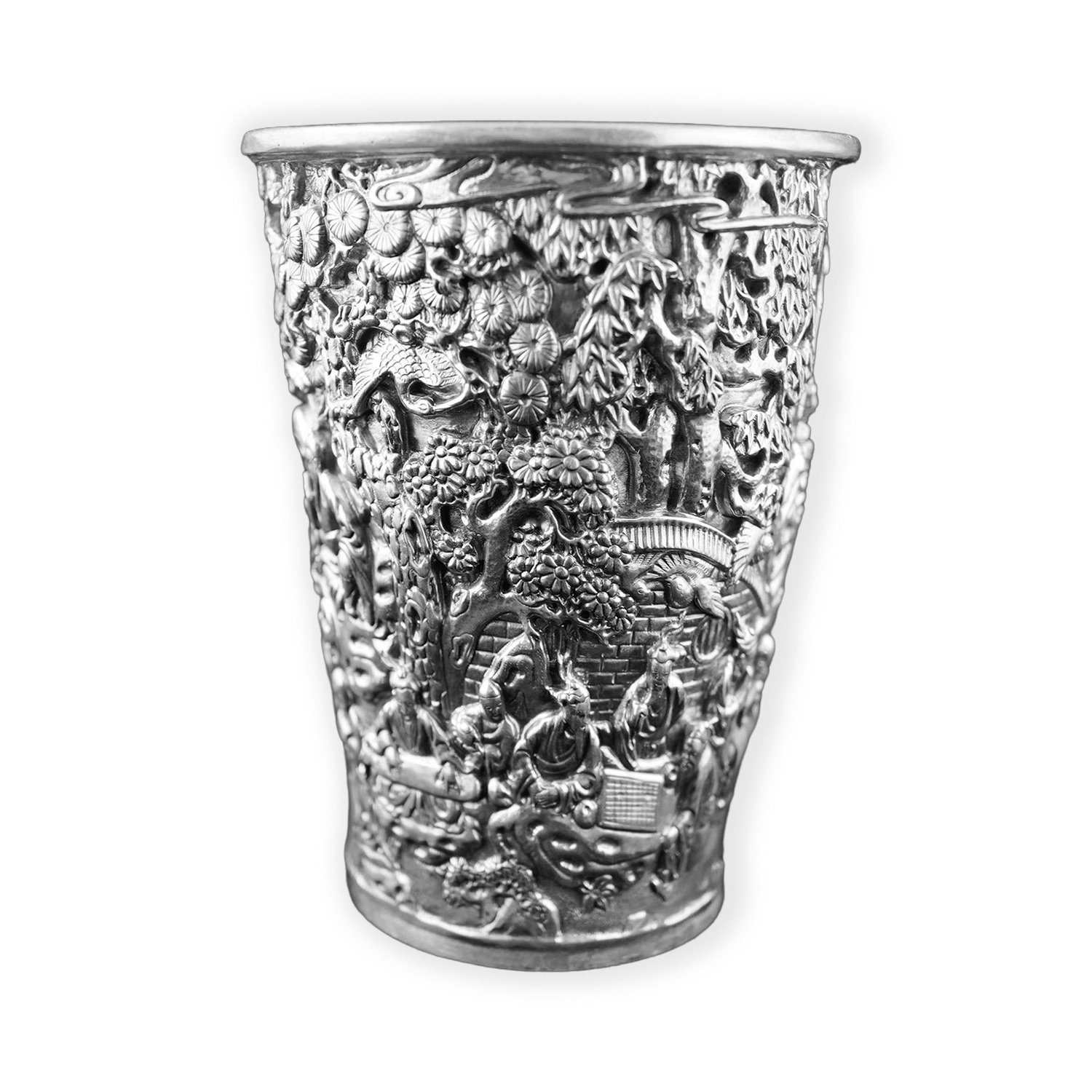 Image 2 of 4
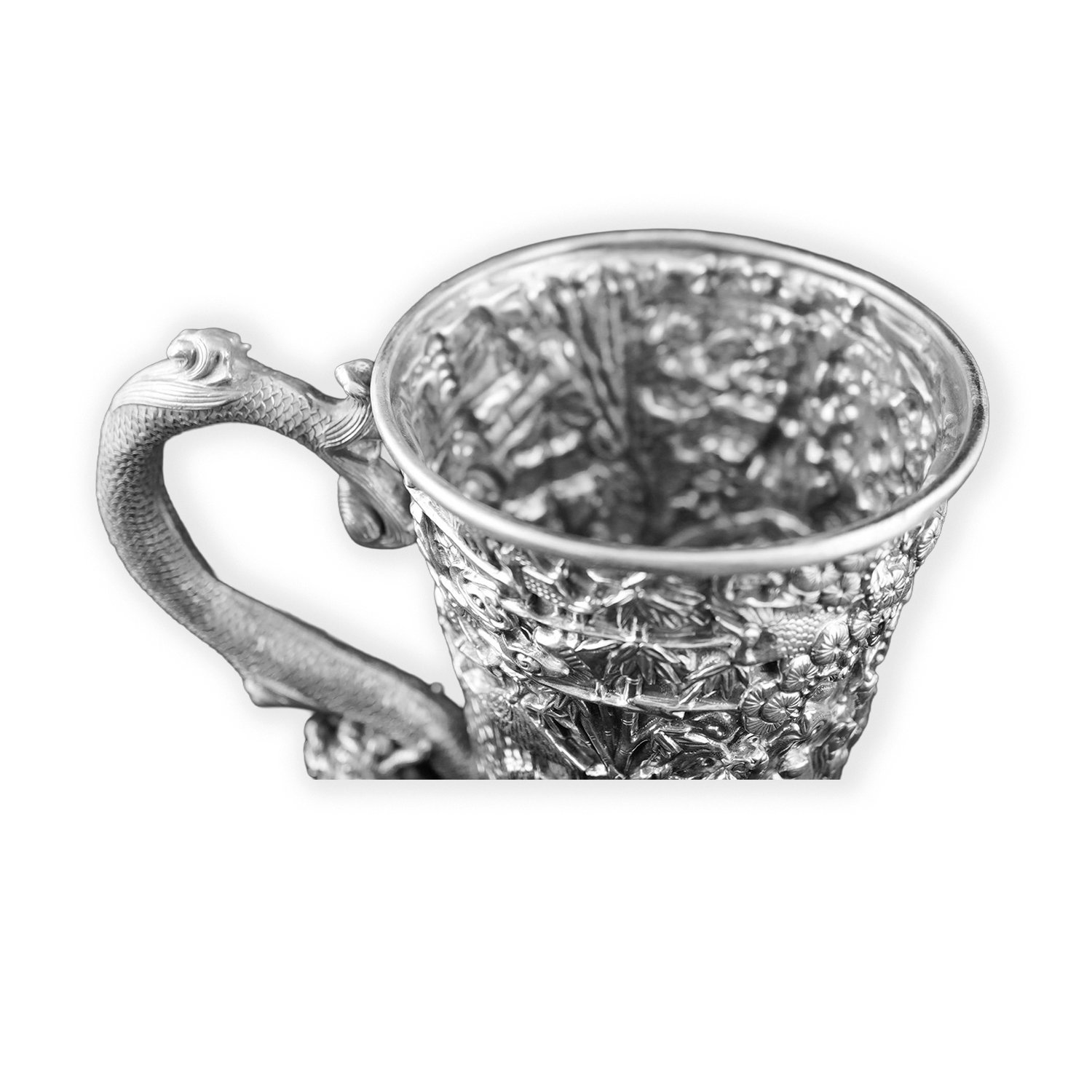 Image 3 of 4
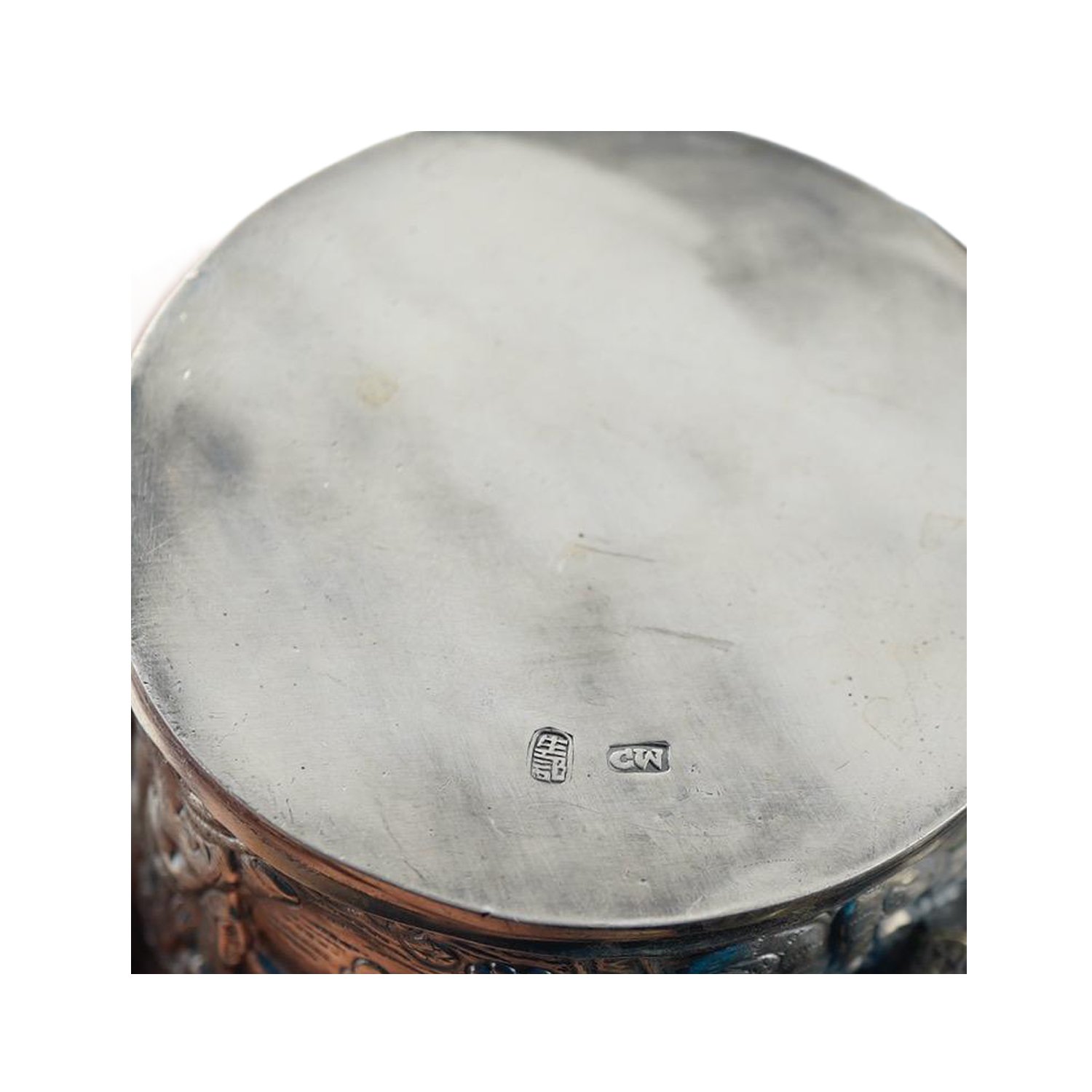 Image 4 of 4
Retailed by Cum Wo, Signed Sheng Ji (生記), 19th c.
The Poet Li Bai & the "Zhuxi Liuyi" Literati at Culai Mountain
Peerless Tang Dynasty poet, Li Bai, who famously drowned drunk in the Yangtze River while trying to embrace the moon's watery reflection astride his boat, was immortalized by his friend Du Fu's satirical poem Yinzhong Baxian (8 Immortals of the Wine Cup - in reality, Li Bai, cavorting with his Imperial & noble literati friends).
Imbibement was Li Bai's method of poetic inspiration, and the reference upon this vessel meant for alcohol consumption is no accident, making it the quintessential Chinese Export Silver drinking vessel of this type.
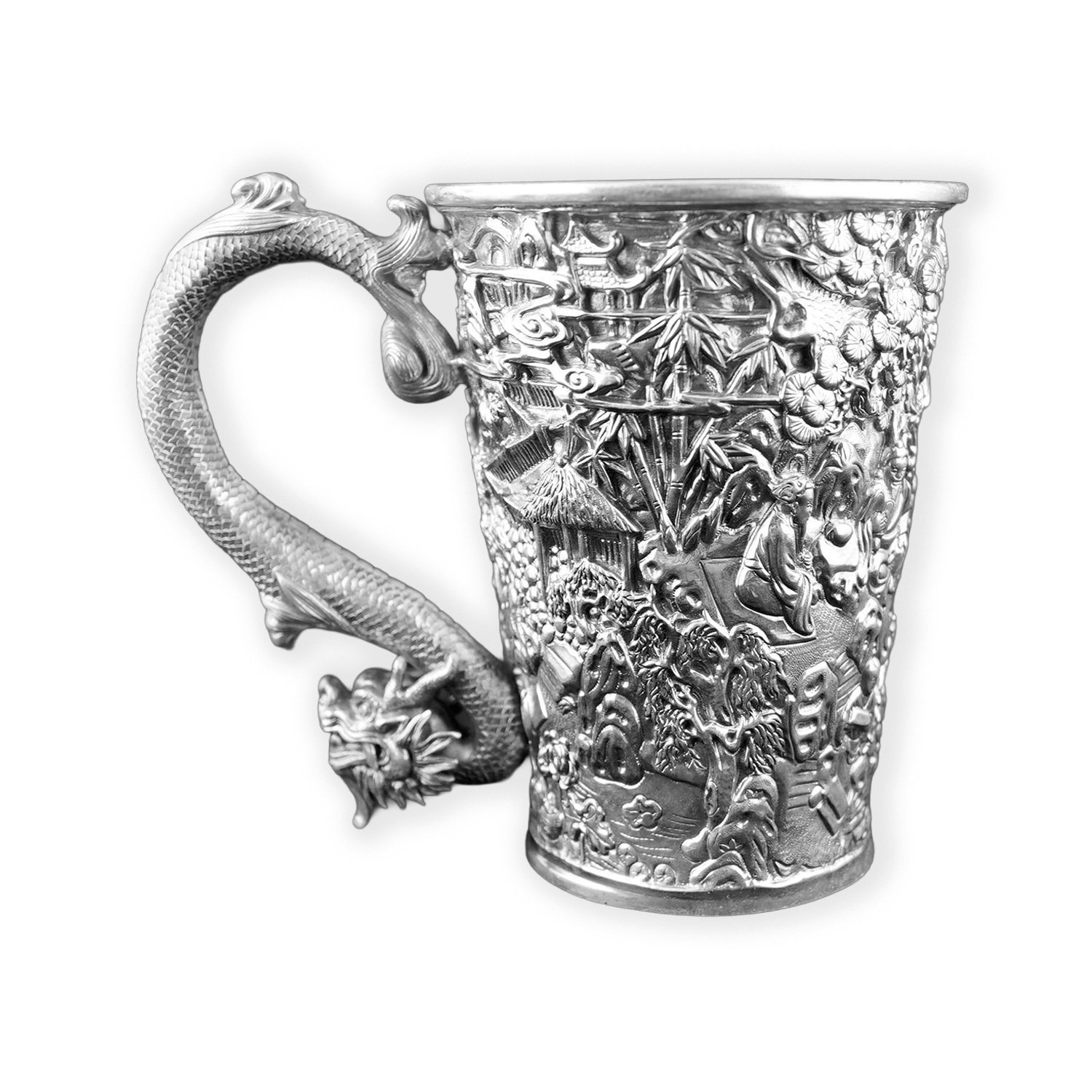
In contrast to the common village vignettes & violent battle scenes typically found on similar vessels, we are instead treated here to a sophisticated diorama of the most elevated pursuits: Li Bai & his renowned literati group, the Zhuxi Liuyi (Li Bai, Pei Zhen, Kong Chaofu, Zhang Shuming, Han Zhun, and Du Fu) engaged in the classical arts of calligraphy, poetry, guzheng, and weiqi (圍棋) - all stimulated by cups of wine flowing from the hands of servant boys.
The literati are surrounded by auspicious symbols of immortality, from lingzhi-covered ancient trees to flying cranes to mist-encircled heights replete with pagodas, bamboo, and viewing stones. The foreground bamboo stream with floating waterfowl & lotus blossoms identifies Li Bai's real-world home in Zhuxi (which means "Bamboo Stream") at Culai Mountain (in Shandong).
Similar depictions of Li Bai & this illustrious group of six can be found on priceless Qianlong jade brush pots (Christie's NYC, 2012: Lot 1035 with the "Zhuxi Liuyi" & at the Palace Museum, Beijing), as well as other forms & media from the Tang to Qing Dynasties, underscoring the scene's rarefied significance. Please see: https://www.christies.com/lot/a-superb-green-jade-brush-pot-bitong-5595864/
This masterpiece beaker-form cann possesses the highest relief repoussé work I and other consulted collectors have ever seen. Thick silver sheets of fine quality are required to achieve such depth without metal failure.
Minimal wear to the relief figures, as in this piece, is also rare in antique Chinese export silver of all kinds. Expressions usually worn-off (as in old silver coin reliefs) can here be discerned on the men's faces, allowing full appreciation of the contemplative scene.
Retailed by Cum Wo, Hong Kong - Workshop of Sheng Ji, Shanghai.
N.B.: This particular form of vessel is today known by several names, depending upon the collector or expert involved, as well as one’s own country of origin / vernacular: Flagon (usually lidded) / Mug / Cann / Beaker (usually handleless), etc.
Notes:
Height: ~ 6” (but seems much larger)
Width: ~ 7" (inc. handle)
Weight: ~ 15 TROY OUNCES
N.B. Antique Asian silver purity is highly variable and will not be estimated.
**NOT** PLATED
SOLID SILVER
Retailed by Cum Wo, Signed Sheng Ji (生記), 19th c.
The Poet Li Bai & the "Zhuxi Liuyi" Literati at Culai Mountain
Peerless Tang Dynasty poet, Li Bai, who famously drowned drunk in the Yangtze River while trying to embrace the moon's watery reflection astride his boat, was immortalized by his friend Du Fu's satirical poem Yinzhong Baxian (8 Immortals of the Wine Cup - in reality, Li Bai, cavorting with his Imperial & noble literati friends).
Imbibement was Li Bai's method of poetic inspiration, and the reference upon this vessel meant for alcohol consumption is no accident, making it the quintessential Chinese Export Silver drinking vessel of this type.
In contrast to the common village vignettes & violent battle scenes typically found on similar vessels, we are instead treated here to a sophisticated diorama of the most elevated pursuits: Li Bai & his renowned literati group, the Zhuxi Liuyi (Li Bai, Pei Zhen, Kong Chaofu, Zhang Shuming, Han Zhun, and Du Fu) engaged in the classical arts of calligraphy, poetry, guzheng, and weiqi (圍棋) - all stimulated by cups of wine flowing from the hands of servant boys.
The literati are surrounded by auspicious symbols of immortality, from lingzhi-covered ancient trees to flying cranes to mist-encircled heights replete with pagodas, bamboo, and viewing stones. The foreground bamboo stream with floating waterfowl & lotus blossoms identifies Li Bai's real-world home in Zhuxi (which means "Bamboo Stream") at Culai Mountain (in Shandong).
Similar depictions of Li Bai & this illustrious group of six can be found on priceless Qianlong jade brush pots (Christie's NYC, 2012: Lot 1035 with the "Zhuxi Liuyi" & at the Palace Museum, Beijing), as well as other forms & media from the Tang to Qing Dynasties, underscoring the scene's rarefied significance. Please see: https://www.christies.com/lot/a-superb-green-jade-brush-pot-bitong-5595864/
This masterpiece beaker-form cann possesses the highest relief repoussé work I and other consulted collectors have ever seen. Thick silver sheets of fine quality are required to achieve such depth without metal failure.
Minimal wear to the relief figures, as in this piece, is also rare in antique Chinese export silver of all kinds. Expressions usually worn-off (as in old silver coin reliefs) can here be discerned on the men's faces, allowing full appreciation of the contemplative scene.
Retailed by Cum Wo, Hong Kong - Workshop of Sheng Ji, Shanghai.
N.B.: This particular form of vessel is today known by several names, depending upon the collector or expert involved, as well as one’s own country of origin / vernacular: Flagon (usually lidded) / Mug / Cann / Beaker (usually handleless), etc.
Notes:
Height: ~ 6” (but seems much larger)
Width: ~ 7" (inc. handle)
Weight: ~ 15 TROY OUNCES
N.B. Antique Asian silver purity is highly variable and will not be estimated.
**NOT** PLATED
SOLID SILVER