 Image 1 of 5
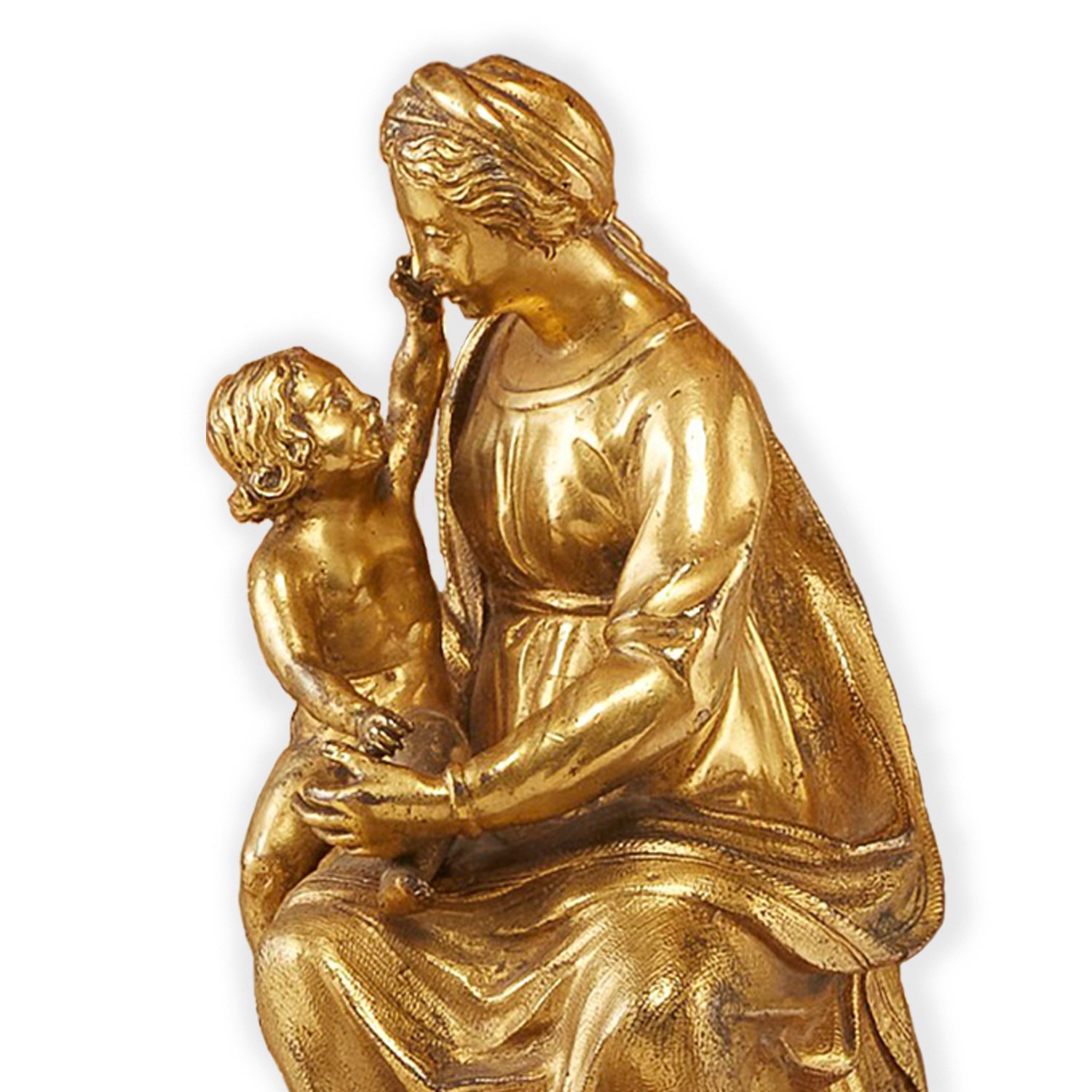 Image 2 of 5
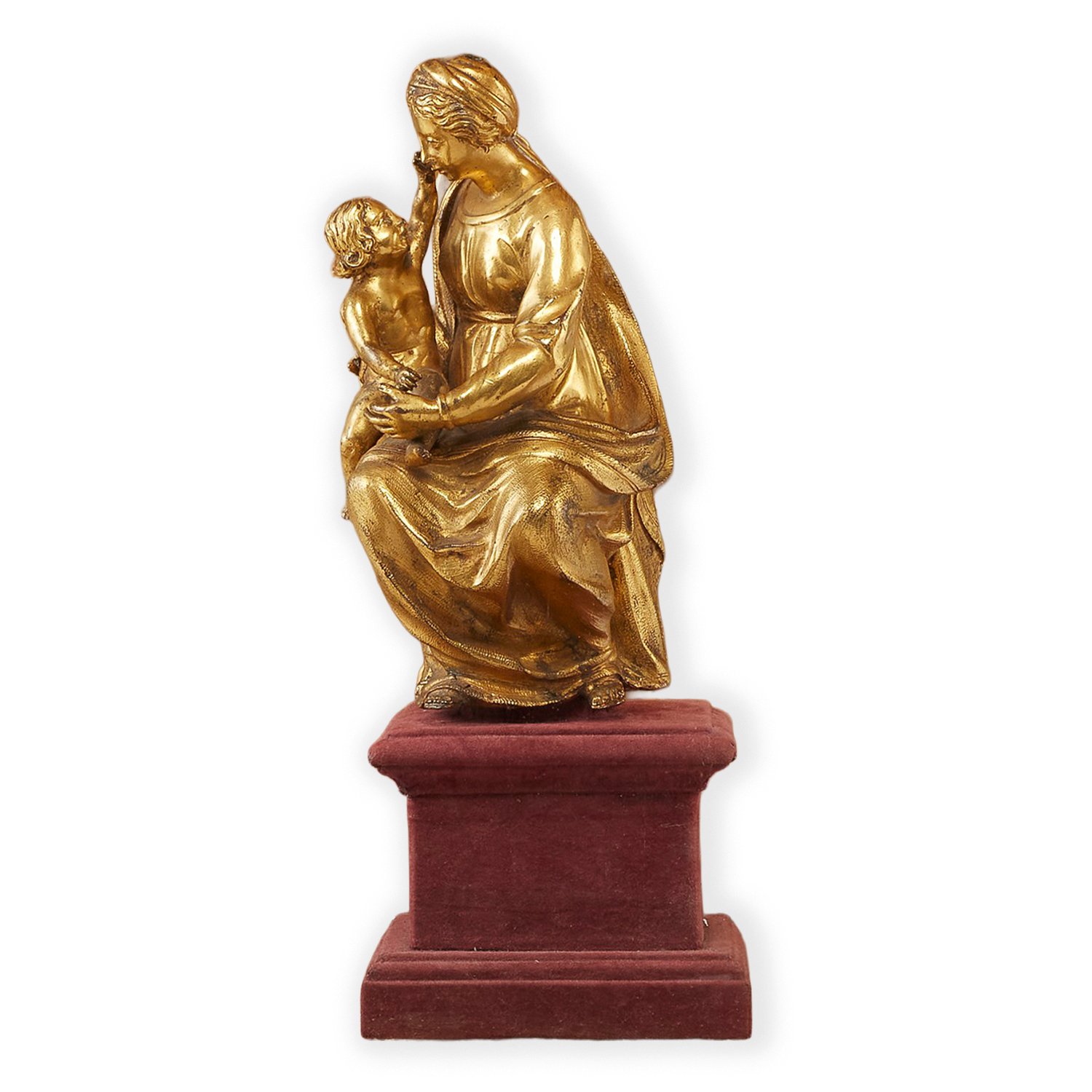 Image 3 of 5
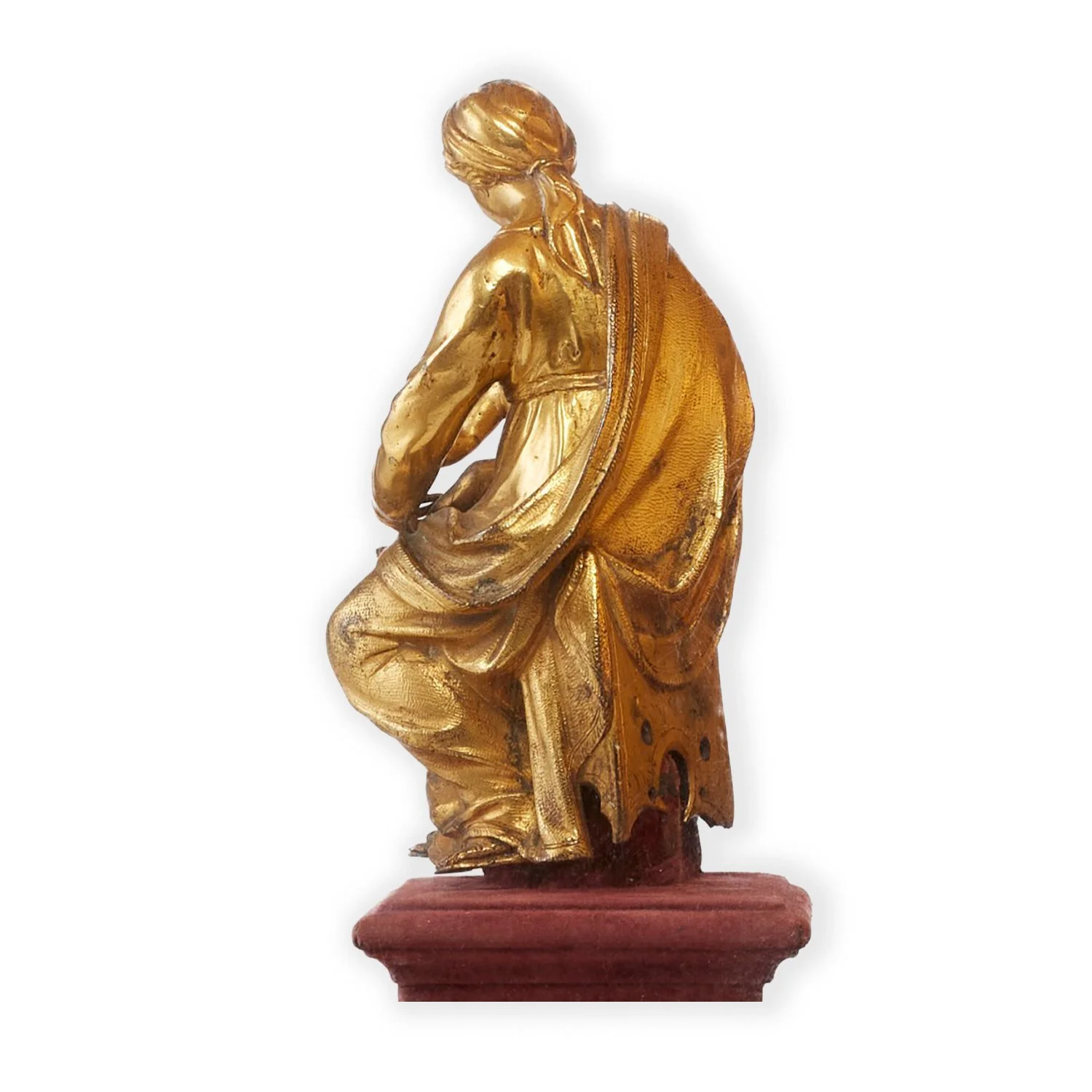 Image 4 of 5
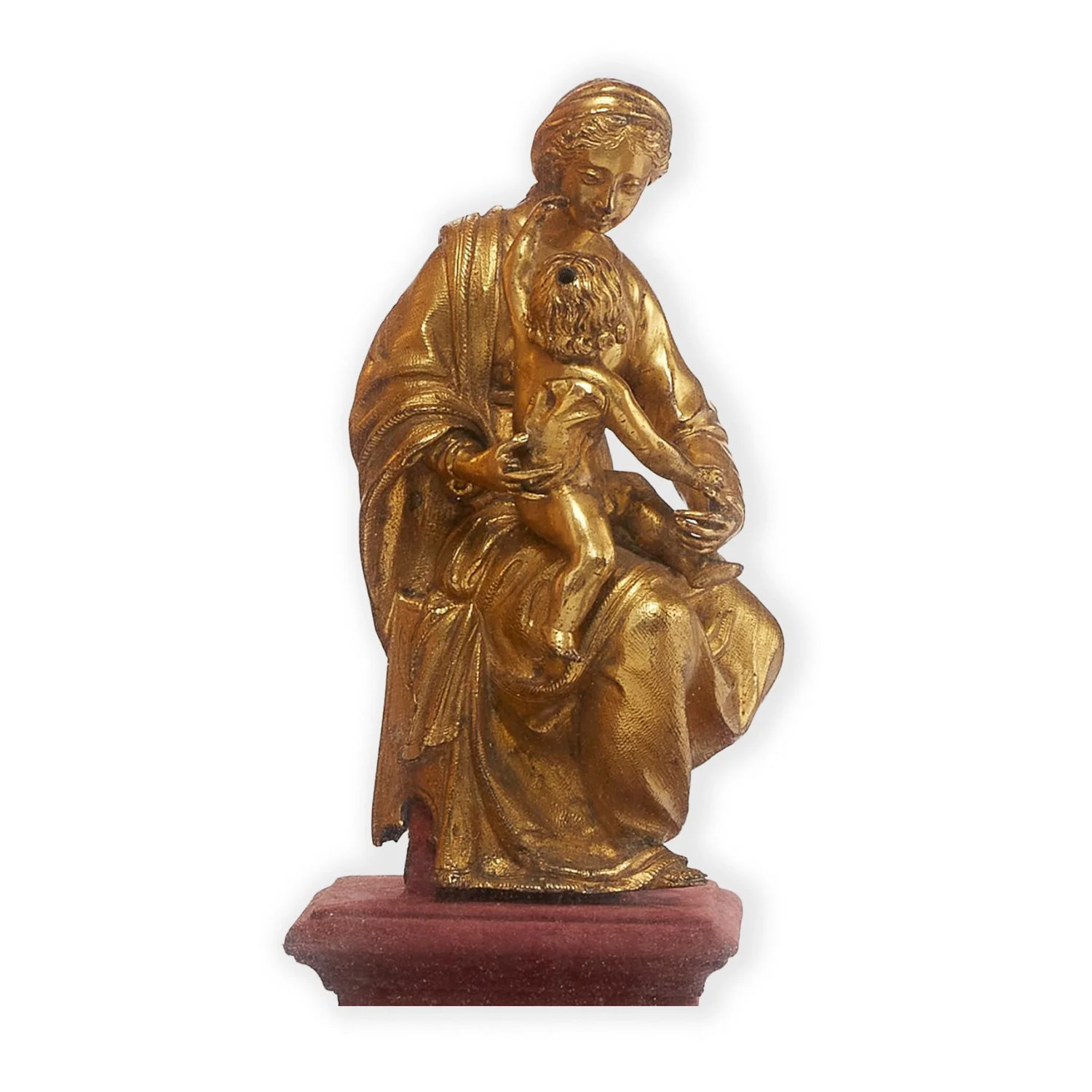 Image 5 of 5
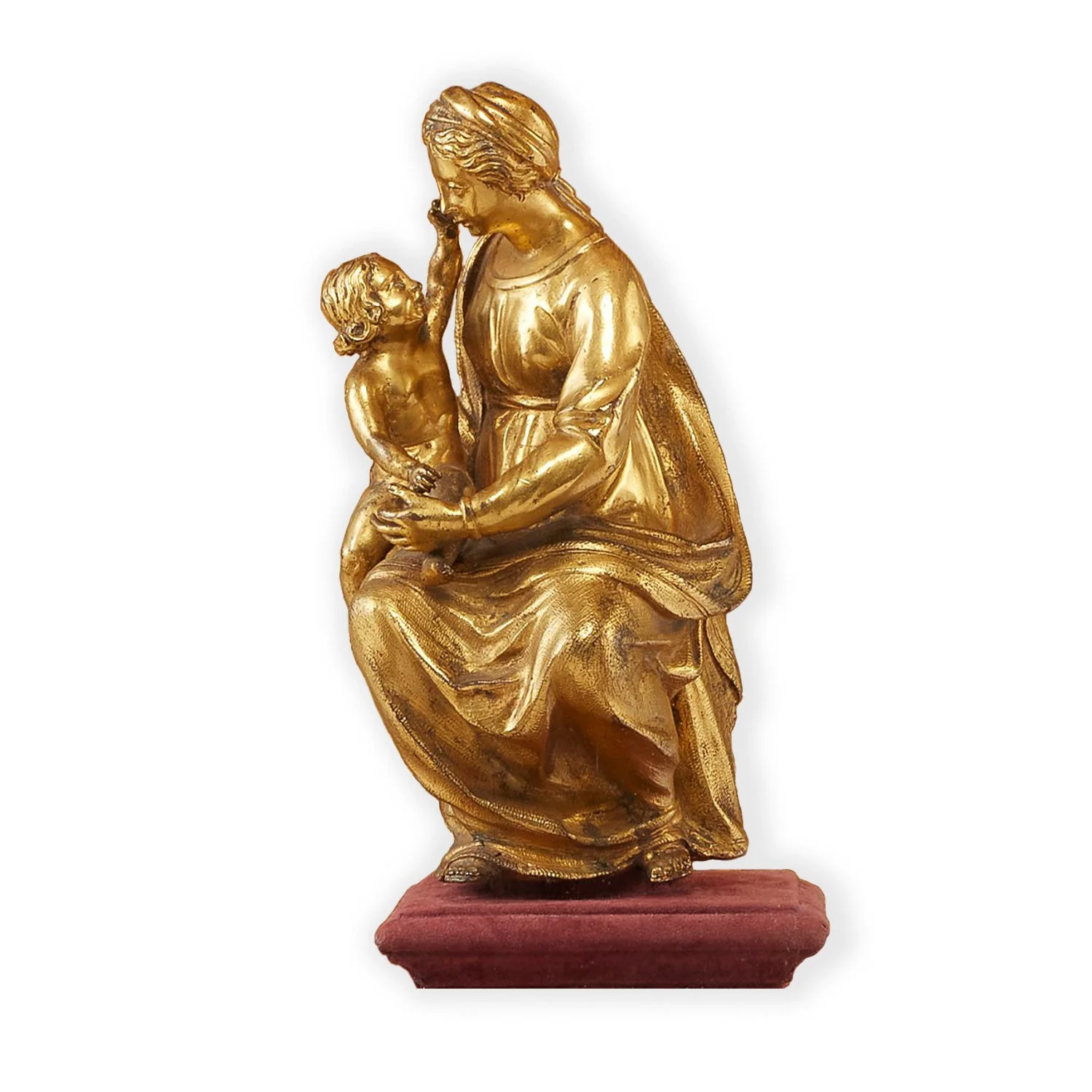
*BARTHELEMY PRIEUR* (1536-1611) ORIGINAL GILT BRONZE MADONNA & CHILD, CIRCA 1600
* Purchased at Christie’s, NYC *
BARTHELEMY PRIEUR (1536 - 1611)
A LOST-WAX CHISELED + FIRE-GILT BRONZE VIRGIN & CHRIST CHILD
JESUS AND MARY CAST SEPARATELY + ASSEMBLED
FRENCH, 16TH CENTURY
Hailing from the circa $50 million Alsdorf Collection (an auctions sales total NOT including those portions endowed to the Chicago Art Institute & other museums over the decades), the signature details revealing this bronze Jesus & Mary Group as the autograph work of Barthelemy Prieur (so replete with the spirit of Giambologna, as Prieur trained in cinquecento Italy in the orbit of the greatest Italian Renaissance masters) were discovered by noted British 16th century Italian bronze statuary expert - and a published specialist on Prieur - Dr. Charles Avery of Cambridge, England (October of 2024).
Dr. Avery has also suggested (N.B. research on-going) that the gilder on this statue listed for sale (which can be yours, upon check-out!) may well have been Prieur’s father-in-law, further locking-down the autograph state of this masterpiece.
After exhaustive research, I consider this to be the definitive original casting - Prieur’s Artist’s Proof, thence set to practical use in a church or tomb - upon which a series of inferior later models were based.
A scholar must, of course, fully appreciate that secular models produced by Prieur (and the esteemed Ponce Jacquio aka Jacquiot, depicting a crouched nude removing a thorn from her foot - transmuted by Prieur into a woman bathing) have heavily influenced the present religious work in terms of anatomical study, and especially, facial structure for Mary as the Mother of God (along with, to a lesser extent, certain facial archetypes attributed to Germain Pilon).
Of greater importance, Prieur’s own models of a secular female nude playfully toweling-dry her son fresh from his bath are in overall thematic parity with our bronze Virgin & Child here offered, and were absolutely produced with this similarity in mind (i.e. Prieur’s secular bronze, Kneeling Mother with Little Boy, either inspired our religious bronze, or our religious bronze by Prieur inspired his own secular variants). The thematic parity is further emphasized by Dr. Avery’s full title for this bronze group: The Virgin Mary seated and playing with the Baby Jesus.
This independently-cast two-figure bronze group is not merely a banal pairing of the Virgin & Christ Child one sees across all centuries (and innumerable artists’ hands)… THIS PRIEUR MASTERPIECE, RENDERED IN THE MOST EXACTING MINIATURE DETAIL, is of an animated, living Baby Jesus, smiling widely, his limbs all flapping in the inimitable joy of infancy, indeed, playing, while his austere, venerable - one might say hauntingly prescient - mother (resembling an oracle; cf. Michelangelo’s Sistine Chapel fresco) looks on, almost jaded by a vision of what will become of a God from her womb in this world.
As such, “profound” is a proper understatement for these two starkly juxtapposed visages: the innocence of the baby, the weary eyes of the mother.
The inimitable hollowed rendering of Mary’s eyes, the separate layers of her tresses (echoed in Jesus’ own curls), heavy-handed treatment of garments, fineness & fragility of the phalanges, and the emotional (almost secular) “normal boy” depiction of Jesus are all in perfect concordance with Prieur’s autograph work, and indeed, his deeper ethos on spirituality.
It’s as if, forced as a Protestant to produce what he might have considered idolatrous, he would purify it by rendering Jesus as humbly and naturalistically as possible, with Mary not as Queen, but as mystic, and ultimately, the suffering, ever harrowed mother.
Owing to Prieur’s Protestant background (and the worldwide 16th century Protestant philosophical detestation of Catholic idolatry, manifesting in physical iconoclasm), his religious works are uncommon on today’s market compared to his secular oeuvres, which routinely fetch half a million to nearly one million dollars in chocolate patinas for, typically, nude female figures (and some male, cf. Mercury, linked below, etc.).
It is no exaggeration to state, therefore, that were our Prieur Virgin & Child (here shown) lacking its stunning gilding, its masterful all-over chiseling, and its garments covering the female physiology (although Jesus is nude, per tradition), instead of a $100,000 bronze, you would be paying $400,000 to $600,000 for it (https://www.christies.com/en/lot/lot-6411288, https://www.christies.com/en/lot/lot-5868935).
Even more ironic is how today’s tastes adjust values from some 430 years ago, as when this bronze was cast, the chocolate secular nudes would have been far cheaper both to produce and to buy, whereas, only the vast wealth of the Church could have paid for the time & labor required to make a gilt bronze such as this.
It’s all just a question of what one elevates when it comes to price. But, there is no opinion involved when it comes to WHICH type of bronze required more work, a higher price of raw materials, and overall value-input for creation: this Alsdorf Prieur Madonna & Child blows them all away…
For the discerning collector, this is Prieur’s epitome of sacred art.
As a pleasing finish, we also have the antique wooden base (as photographed above, lined in pink suede), so alike in form to the other great Prieur secular bronzes (observe the base in https://www.christies.com/en/lot/lot-6411288 ), with the further option to display your Prieur after purchase in its LARGE original, stunning Alsdorf relictuary enclosure - itself a work of art worth at least $3,000-$5,000 (included free with purchase of the bronze, at the buyer’s request).
THE STORY:
At the Christie’s Alsdorf Collection auction where we bought this bronze, it was a mystery - flummoxing staff, who left it to hammer, totally unattributed as to artist.
James & Marilyn Alsdorf, the original owners, had, of course, passed-away, and could be of no assistance. The Covid-19 chaos not only diminished the coffers of so many collectors & dealers as the DJI crashed nearly 10,000 points from January 2020 to April 2020 (to speak only of American indices!), but also prevented in-person inspection straight through 2021 (by connoisseurs, such as ourselves) of potential sleepers, like this striking bronze group of the Virgin & Child (originally purchased by one of the most edcuated and esteemed bronze-collecting couples in the entire world). If ever there was a time to take seriously ALL the statuary in a major collection, and dispense with customary specialist snobbery, this was it. But, as with so many other auctions during this tragic period, the auction house pridefully flubbed it. They didn’t even put down a name, which in the end, is a great fortune for the successful bidder, who can then take the time (without any alternative attributions) to conduct proper scholarship, de novo, as if it were new, at his or her own expense.
As, indeed, we did! :-)
Notable also was that its small size (circa 7" tall) inside its gorgeous period giltwood relictuary with glass walls (a structure nearly 10x the volume of this diminutive bronze) - combined with its camoflauged look as a gilded bronze against gilded wood - rendered this Prieur nearly INVISIBLE when photographed. Catalog illustrations, thus, attracted more the eye of collectors who prized the resplendent columnar & domed circa 16th-17th architectural enclosure - not the hidden statuary inside.
No photographs of the bronze group, by itself, were ever provided for auction.
Moving along from the tomfoolery of corporations too large to treat all objects with equal inquisitive scholarship (when the work has not already been done for them by provenance, stature, and repute), I leave you with some closing general remarks…
This typical ~7” small bronze height - along with the casting, chiseling, and choice of surface texture across drapery & flesh - is an exact match to the autograph work of Barthelemy Prieur.
Small bronzes of this period, which scholars attribute reproductive proliferation of largely (with respect to France) to Prieur’s techniques brought from Italy (where his youthful craft was honed; cf. the “indirect” lost-wax casting method), fed a sophisticated trade that burgeoned in 16th century Paris. The present model appears to have been part of Prieur's ecclesiastical output from the late 16th to early 17th century, and most likely originated as the head of a scepter (vestigial attachments remain), a component of a Church figural assemblage, or a devotional fragment of a domestic altar / kneeler.
Prieur’s style & execution betray heavy influences from both Giambologna and Michelangelo. The relationship of the figures in this group resembles Michelangelo’s marble Madonna & Child in the Medici Sacristy in Florence (which Prieur would have seen). Prieur’s naturalistic reanimation of the Christ Child as a normal human boy (abovementioned) - and his recasting of the scene with his own unique “Prieurean” religious sensibilities - does not overwrite the fundamental positional / postural similarities between the two.
Echoes of Giambologna's terracotta of Thetis (c. 1580, the V&A) may also be seen in the present composition in both manner & geometry, together with a similar arc in the base for functional mounting in situ. Indeed, Prieur’s similarities to Giambologna & his studio led us first to an attribution favoring this Italian master, when the subsequent work of Dr. Avery revealed precisely why our eyes were leading us in this Italian direction: Prieur lived, worked, and was shaped in ALL his future creations (as with most of the world’s greatest artists: Dutch, French, or whathaveyou!) by these living masters, such as Giambologna, in 16th century Renaissance Italy!!! :-)
Note: The hole for a historic halo mount upon the head of Jesus, and the two missing fingers (as seen in other autograph gilt Prieur’s, due to the fineness of casting) on Mary’s right hand.
Provenance:
With Royal Athena Galleries, New York, 1987.
Alsdorf Collection, Chicago.
Christie's, Old Masters: The Alsdorf Collection, 2021.
Property of a Taiwan Forbes List Family.
Property of a Philanthropist of the Arts & Sciences.
* Purchased at Christie’s, NYC *
BARTHELEMY PRIEUR (1536 - 1611)
A LOST-WAX CHISELED + FIRE-GILT BRONZE VIRGIN & CHRIST CHILD
JESUS AND MARY CAST SEPARATELY + ASSEMBLED
FRENCH, 16TH CENTURY
Hailing from the circa $50 million Alsdorf Collection (an auctions sales total NOT including those portions endowed to the Chicago Art Institute & other museums over the decades), the signature details revealing this bronze Jesus & Mary Group as the autograph work of Barthelemy Prieur (so replete with the spirit of Giambologna, as Prieur trained in cinquecento Italy in the orbit of the greatest Italian Renaissance masters) were discovered by noted British 16th century Italian bronze statuary expert - and a published specialist on Prieur - Dr. Charles Avery of Cambridge, England (October of 2024).
Dr. Avery has also suggested (N.B. research on-going) that the gilder on this statue listed for sale (which can be yours, upon check-out!) may well have been Prieur’s father-in-law, further locking-down the autograph state of this masterpiece.
After exhaustive research, I consider this to be the definitive original casting - Prieur’s Artist’s Proof, thence set to practical use in a church or tomb - upon which a series of inferior later models were based.
A scholar must, of course, fully appreciate that secular models produced by Prieur (and the esteemed Ponce Jacquio aka Jacquiot, depicting a crouched nude removing a thorn from her foot - transmuted by Prieur into a woman bathing) have heavily influenced the present religious work in terms of anatomical study, and especially, facial structure for Mary as the Mother of God (along with, to a lesser extent, certain facial archetypes attributed to Germain Pilon).
Of greater importance, Prieur’s own models of a secular female nude playfully toweling-dry her son fresh from his bath are in overall thematic parity with our bronze Virgin & Child here offered, and were absolutely produced with this similarity in mind (i.e. Prieur’s secular bronze, Kneeling Mother with Little Boy, either inspired our religious bronze, or our religious bronze by Prieur inspired his own secular variants). The thematic parity is further emphasized by Dr. Avery’s full title for this bronze group: The Virgin Mary seated and playing with the Baby Jesus.
This independently-cast two-figure bronze group is not merely a banal pairing of the Virgin & Christ Child one sees across all centuries (and innumerable artists’ hands)… THIS PRIEUR MASTERPIECE, RENDERED IN THE MOST EXACTING MINIATURE DETAIL, is of an animated, living Baby Jesus, smiling widely, his limbs all flapping in the inimitable joy of infancy, indeed, playing, while his austere, venerable - one might say hauntingly prescient - mother (resembling an oracle; cf. Michelangelo’s Sistine Chapel fresco) looks on, almost jaded by a vision of what will become of a God from her womb in this world.
As such, “profound” is a proper understatement for these two starkly juxtapposed visages: the innocence of the baby, the weary eyes of the mother.
The inimitable hollowed rendering of Mary’s eyes, the separate layers of her tresses (echoed in Jesus’ own curls), heavy-handed treatment of garments, fineness & fragility of the phalanges, and the emotional (almost secular) “normal boy” depiction of Jesus are all in perfect concordance with Prieur’s autograph work, and indeed, his deeper ethos on spirituality.
It’s as if, forced as a Protestant to produce what he might have considered idolatrous, he would purify it by rendering Jesus as humbly and naturalistically as possible, with Mary not as Queen, but as mystic, and ultimately, the suffering, ever harrowed mother.
Owing to Prieur’s Protestant background (and the worldwide 16th century Protestant philosophical detestation of Catholic idolatry, manifesting in physical iconoclasm), his religious works are uncommon on today’s market compared to his secular oeuvres, which routinely fetch half a million to nearly one million dollars in chocolate patinas for, typically, nude female figures (and some male, cf. Mercury, linked below, etc.).
It is no exaggeration to state, therefore, that were our Prieur Virgin & Child (here shown) lacking its stunning gilding, its masterful all-over chiseling, and its garments covering the female physiology (although Jesus is nude, per tradition), instead of a $100,000 bronze, you would be paying $400,000 to $600,000 for it (https://www.christies.com/en/lot/lot-6411288, https://www.christies.com/en/lot/lot-5868935).
Even more ironic is how today’s tastes adjust values from some 430 years ago, as when this bronze was cast, the chocolate secular nudes would have been far cheaper both to produce and to buy, whereas, only the vast wealth of the Church could have paid for the time & labor required to make a gilt bronze such as this.
It’s all just a question of what one elevates when it comes to price. But, there is no opinion involved when it comes to WHICH type of bronze required more work, a higher price of raw materials, and overall value-input for creation: this Alsdorf Prieur Madonna & Child blows them all away…
For the discerning collector, this is Prieur’s epitome of sacred art.
As a pleasing finish, we also have the antique wooden base (as photographed above, lined in pink suede), so alike in form to the other great Prieur secular bronzes (observe the base in https://www.christies.com/en/lot/lot-6411288 ), with the further option to display your Prieur after purchase in its LARGE original, stunning Alsdorf relictuary enclosure - itself a work of art worth at least $3,000-$5,000 (included free with purchase of the bronze, at the buyer’s request).
THE STORY:
At the Christie’s Alsdorf Collection auction where we bought this bronze, it was a mystery - flummoxing staff, who left it to hammer, totally unattributed as to artist.
James & Marilyn Alsdorf, the original owners, had, of course, passed-away, and could be of no assistance. The Covid-19 chaos not only diminished the coffers of so many collectors & dealers as the DJI crashed nearly 10,000 points from January 2020 to April 2020 (to speak only of American indices!), but also prevented in-person inspection straight through 2021 (by connoisseurs, such as ourselves) of potential sleepers, like this striking bronze group of the Virgin & Child (originally purchased by one of the most edcuated and esteemed bronze-collecting couples in the entire world). If ever there was a time to take seriously ALL the statuary in a major collection, and dispense with customary specialist snobbery, this was it. But, as with so many other auctions during this tragic period, the auction house pridefully flubbed it. They didn’t even put down a name, which in the end, is a great fortune for the successful bidder, who can then take the time (without any alternative attributions) to conduct proper scholarship, de novo, as if it were new, at his or her own expense.
As, indeed, we did! :-)
Notable also was that its small size (circa 7" tall) inside its gorgeous period giltwood relictuary with glass walls (a structure nearly 10x the volume of this diminutive bronze) - combined with its camoflauged look as a gilded bronze against gilded wood - rendered this Prieur nearly INVISIBLE when photographed. Catalog illustrations, thus, attracted more the eye of collectors who prized the resplendent columnar & domed circa 16th-17th architectural enclosure - not the hidden statuary inside.
No photographs of the bronze group, by itself, were ever provided for auction.
Moving along from the tomfoolery of corporations too large to treat all objects with equal inquisitive scholarship (when the work has not already been done for them by provenance, stature, and repute), I leave you with some closing general remarks…
This typical ~7” small bronze height - along with the casting, chiseling, and choice of surface texture across drapery & flesh - is an exact match to the autograph work of Barthelemy Prieur.
Small bronzes of this period, which scholars attribute reproductive proliferation of largely (with respect to France) to Prieur’s techniques brought from Italy (where his youthful craft was honed; cf. the “indirect” lost-wax casting method), fed a sophisticated trade that burgeoned in 16th century Paris. The present model appears to have been part of Prieur's ecclesiastical output from the late 16th to early 17th century, and most likely originated as the head of a scepter (vestigial attachments remain), a component of a Church figural assemblage, or a devotional fragment of a domestic altar / kneeler.
Prieur’s style & execution betray heavy influences from both Giambologna and Michelangelo. The relationship of the figures in this group resembles Michelangelo’s marble Madonna & Child in the Medici Sacristy in Florence (which Prieur would have seen). Prieur’s naturalistic reanimation of the Christ Child as a normal human boy (abovementioned) - and his recasting of the scene with his own unique “Prieurean” religious sensibilities - does not overwrite the fundamental positional / postural similarities between the two.
Echoes of Giambologna's terracotta of Thetis (c. 1580, the V&A) may also be seen in the present composition in both manner & geometry, together with a similar arc in the base for functional mounting in situ. Indeed, Prieur’s similarities to Giambologna & his studio led us first to an attribution favoring this Italian master, when the subsequent work of Dr. Avery revealed precisely why our eyes were leading us in this Italian direction: Prieur lived, worked, and was shaped in ALL his future creations (as with most of the world’s greatest artists: Dutch, French, or whathaveyou!) by these living masters, such as Giambologna, in 16th century Renaissance Italy!!! :-)
Note: The hole for a historic halo mount upon the head of Jesus, and the two missing fingers (as seen in other autograph gilt Prieur’s, due to the fineness of casting) on Mary’s right hand.
Provenance:
With Royal Athena Galleries, New York, 1987.
Alsdorf Collection, Chicago.
Christie's, Old Masters: The Alsdorf Collection, 2021.
Property of a Taiwan Forbes List Family.
Property of a Philanthropist of the Arts & Sciences.